
Key takeaways:
The article discusses the types of industrial robots, the applications of robotic workstations, and the key safety requirements under EN ISO 10218-1.
- Industrial robots increase the efficiency, precision, and repeatability of processes across many industries, including automotive and electronics.
- The types of robots described are Cartesian, SCARA, cylindrical, spherical, and delta, together with their typical applications.
- Robotic workstations support welding, assembly, packaging, and machining, among other processes, improving workplace safety.
- The benefits identified were 24/7 operation, fewer errors, reduced risk to workers, and production flexibility.
- The EN ISO 10218-1 standard emphasizes hazard identification, risk assessment, and the design of safe robotic systems.
Industrial robots are advanced automated systems designed to perform tasks related to production, assembly, and material handling. Thanks to their precision, speed, and efficiency, these robots play a key role in modernizing and optimizing industrial processes. In today’s rapidly evolving technological landscape, industrial robots are becoming an essential part of many sectors, from automotive and electronics to pharmaceuticals.
Types of Industrial Robots and Application Possibilities
Industrial robots can be divided into several basic categories, depending on their design and intended use:
- Cartesian Robots: They have three linear axes of motion that move along the X, Y, and Z axes. They are widely used in pick-and-place processes, assembly, and CNC applications.
- SCARA Robots: These robots have four degrees of freedom and are particularly effective in component assembly, packaging, and material handling.
- Cylindrical Robots: They use cylindrical motion and are applied in welding, casting, and assembly operations.
- Spherical Robots: They use spherical motion and are applied in assembly and handling processes where precise positioning is required.
- Delta Robots: They feature a lightweight design and are used in high-speed pick-and-place applications, packaging, and sorting.
Industrial robots are used across a wide range of industries, including automotive, electronics, food, pharmaceuticals, and many others. Their versatility and ability to perform complex tasks make them indispensable in modern industry.
Most Popular Industrial Robot Manufacturers
Several leading manufacturers dominate the industrial robotics sector, holding significant market shares both in Europe and in Poland. Here is an overview of the key players:
| Manufacturer | European market share (%) | Polish market share (%) |
|---|---|---|
| ABB | 20 | 22 |
| KUKA | 18 | 19 |
| FANUC | 15 | 16 |
| Yaskawa | 14 | 12 |
| Universal Robots | 10 | 9 |
| Other | 23 | 22 |
These figures come from the latest market reports and analyses, which indicate the dominance of a few major players in the industrial robotics market. ABB, KUKA, FANUC, and Yaskawa stand out for their innovation and broad product portfolios tailored to a variety of industrial needs (Fortune Business Insights) (Expert Market Research) (Market Research Future).
Industrial Robots: Robotic Workstations
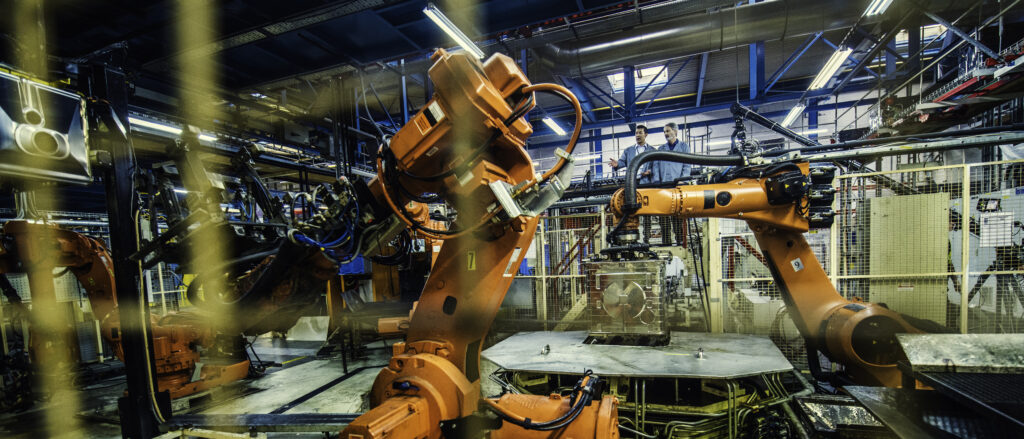
Robotic workstations are specially designed work areas equipped with industrial robots to perform specific tasks. These workstations can be used in various applications, such as welding, assembly, machining, or packaging. Implementing robotic workstations brings numerous benefits, including greater efficiency, precision, and workplace safety.
Benefits of Using Robotic Workstations
- Increased Efficiency: Industrial robots can operate 24 hours a day, 7 days a week, significantly increasing production output. By automating processes, companies can achieve higher product quality in less time.
- Precision and Repeatability: Robots perform tasks with high precision and repeatability, which minimizes production errors and ensures consistent product quality.
- Worker Safety: Using robots for hazardous tasks, such as welding or material processing, significantly reduces the risk of workplace accidents. Robots can operate in demanding conditions where human presence would be dangerous.
- Flexibility: Robotic workstations can be easily adapted to different tasks and production processes, increasing manufacturing flexibility and enabling a rapid response to market changes.
Examples of Robotic Workstation Applications
- Welding: Welding robots are widely used in the automotive industry, where precision and speed are critical. With advanced technologies such as laser welding, it is possible to achieve high-quality welds.
- Assembly: Assembly robots are used to assemble electronic, mechanical, and other components. Precision manipulators enable fast and accurate assembly of even the smallest parts.
- Packaging: Packaging robots automate the product packing process, speeding up the entire production line. Thanks to advanced vision systems, robots can identify and sort products of different shapes and sizes.
- Machining: Robots can be equipped with various machining tools, such as milling, turning, or grinding. Automating these processes improves production precision and efficiency.
Industrial Robots: Key Requirements of EN ISO 10218-1
EN ISO 10218-1 sets out a range of requirements and guidelines intended to ensure the safe use of industrial robots. Below are ten of the most important aspects of this standard:
1. Hazard Identification and Risk Assessment
Identifying potential hazards associated with industrial robots and assessing risk are fundamental steps in ensuring safety. The standard requires all hazards to be identified and the risk to be assessed. Based on this assessment, appropriate protective measures are implemented to minimize risk for operators and other workers.
The risk assessment process should include identification of all potential hazards and evaluation of the associated risk, as well as implementation of appropriate protective measures.”
2. Design of Safe Robotic Systems
Designing robotic systems in accordance with the standard must take risk reduction into account at the design stage. This applies to power transmission components, electrical equipment, and control systems. All of these elements must be designed to ensure the highest level of operational safety.
3. Protective Measures
EN ISO 10218-1 specifies requirements for protective measures such as physical barriers, interlocks, and emergency stop devices. These measures are intended to prevent accidental access to hazardous robot work zones and to ensure that the robot can be stopped quickly and safely in emergency situations.
4. Safety-Related Control Systems
Robot control systems must meet specified performance criteria to ensure that any failure leads to a safe state. The standard requires these systems to be designed in a way that minimizes the risk of failure and provides appropriate protective mechanisms in the event of technical problems.
5. Safe Robot Operation
The standard defines requirements for safe robot operation, including procedures for start-up, shutdown, and switching operating modes. It is important that operators are properly trained and aware of the potential hazards associated with robot use.
6. Operating Instructions and Documentation
Each robot must be supplied with complete documentation, including operating instructions, safety warnings, and maintenance guidelines. This documentation is a key part of ensuring safety and must be readily available to all robot users.
7. Operator Training
Industrial robot operators must be properly trained in the safe use of the equipment. Training should cover both theoretical and practical aspects of robot operation, as well as procedures for responding to emergency situations.
8. Maintenance and Technical Inspections
Regular maintenance and technical inspections are essential to keep robots in a safe operating condition. The standard specifies requirements for the frequency and scope of inspections, as well as maintenance procedures that must be carried out by qualified personnel.
9. Conformity Assessment and Certification
Industrial robots must meet the requirements of EN ISO 10218-1 and other relevant safety standards. Conformity assessment and certification are key elements in ensuring that robots meet all required safety criteria before being placed on the market.
10. Post-Implementation Review
Once robots have been deployed in the workplace, their operation must be checked and monitored regularly. The aim is to ensure they continue to meet safety requirements and to identify and eliminate potential hazards that may arise during use.
Industrial robots and robotic workstations play a key role in modern industry, delivering higher productivity, precision, and safety. Implementing safety standards such as EN ISO 10218-1 is essential to minimize risk and protect workers. As robotics technology continues to advance, its importance and use across different industrial sectors are expected to grow further. The future of industrial robotics is promising, with many new applications and innovations that could transform manufacturing and other industries.
Industrial Robots and the CE Mark
Although industrial robots are often part of larger integrated systems, they must meet specific requirements to obtain the CE mark. The CE mark is required on many products sold within the European Economic Area (EEA) and indicates that the product meets European health, safety, and environmental protection requirements.
Partly Completed Machinery
Industrial robots are treated as partly completed machinery because they usually need to be integrated with other systems as part of larger production lines. Under the Machinery Directive (2006/42/EC), partly completed machinery cannot be CE marked on its own. However, it must still meet certain requirements:
- Declaration of Incorporation:
- The manufacturer of partly completed machinery must provide a Declaration of Incorporation stating that the machinery is intended to be incorporated into other machinery or systems and cannot be used on its own until it has been integrated and assessed in accordance with the Machinery Directive.
- Assembly Instructions:
- The manufacturer must provide detailed assembly instructions specifying how to safely integrate the partly completed machinery with other equipment.
Final CE Certification Process
When an industrial robot is integrated with other systems as part of a larger machine, responsibility for obtaining full CE marking lies with the final manufacturer. The CE certification process includes:
- Conformity Assessment:
- The entire integrated system must undergo a conformity assessment in accordance with the relevant directives, including the Machinery Directive (2006/42/EC), the EMC Directive (2014/30/EU), and other applicable directives such as the Low Voltage Directive (LVD).
- Technical Documentation:
- The final manufacturer must prepare complete technical documentation containing information on all integrated components, the risk assessment, and conformity testing.
- EC Declaration of Conformity:
- The final manufacturer must draw up an EC Declaration of Conformity stating that the entire integrated system meets all requirements of the relevant directives.
- CE Marking:
- Once the conformity assessment process has been completed and the EC Declaration of Conformity has been drawn up, the final manufacturer may affix the CE mark to the entire integrated system (note: a CE mark on the robot itself does not apply to the Machinery Directive).
Industrial Robots: Practical Aspects
Example
A company that integrates industrial robots supplies its products as parts of larger production automation systems. Each robot is delivered with a Declaration of Incorporation and assembly instructions. The integrator that incorporates these robots into a production line is responsible for ensuring that the entire system complies with EU directives and for obtaining the CE mark for the complete system.
Industrial Automation and Industrial Robots
Industrial automation and industrial robots are two key elements of modern manufacturing that work closely together to optimize processes and improve efficiency. Their interaction spans a wide range of areas, from design and programming to implementation and system maintenance.
- Production Process Automation:
- Industrial automation uses industrial robots to automate various stages of production, increasing efficiency and reducing costs. These robots can be programmed to perform precise tasks such as assembly, welding, and packaging.
- PLC Programming:
- PLC programming (Programmable Logic Controllers) plays a key role in integrating industrial robots with other automation systems. PLCs control robot operation, ensuring synchronization and the smooth functioning of the entire production system.
- Design Office and Machine Design:
- Design offices are responsible for designing machines that work with industrial robots. Machine design includes developing components and systems that are compatible with robots, which is essential for effective automation.
- Machine Safety and Harmonized Standards:
- Ensuring machine safety is one of the most important aspects of integrating industrial automation and robots. Harmonized standards, such as EN ISO 10218-1, define the safety requirements that must be met for systems to operate safely and efficiently.
- Engineering Outsourcing:
- Engineering outsourcing allows companies to bring in specialists to design, program, and implement automation and robotics systems. This gives businesses access to the latest technologies and expert knowledge without the need to maintain a large permanent engineering team.
- Industrial Machine Construction:
- Industrial machine construction includes the integration of robots and automation systems. Machine design must be adapted to work with robots, which requires careful planning and coordination between different engineering teams.
Industrial automation and industrial robots form complex, integrated systems that require collaboration at many levels, from design and programming to implementation and maintenance. Harmonized standards and machine safety are essential to ensure that these systems operate efficiently and safely.
Industrial Robots: Safe Robotic Workstations
Robotic workstations are specially designed work areas equipped with industrial robots to perform specific tasks such as welding, assembly, machining, or packaging.
The most commonly cited benefits are greater efficiency (24/7 operation), high precision and repeatability, and improved safety by assigning hazardous tasks to the robot.
Cartesian, SCARA, cylindrical, spherical, and delta robots were listed, together with examples of typical applications (e.g. pick-and-place, assembly, packaging, sorting).
The article describes, among other things, welding, assembly, packaging, and machining, where robots can be equipped with tools for milling, turning, or grinding.
It focuses on hazard identification and risk assessment, as well as the design of safe systems, protective measures (e.g. guards, interlocks, emergency stop devices), and requirements for safety-related control systems.