
Key takeaways:
The introduction explains the basics of PLC programming, common languages, and examples of industrial applications. It also highlights the legal and standardization requirements related to machine safety.
- A PLC is a digital controller used for automation: it collects signals from sensors, processes them, and controls actuators.
- The key PLC components were described: the processor, I/O modules, memory, and the communication interface.
- Overview of PLC languages: LD, ST, FBD, IL, SFC, and SCL, including typical applications and characteristics
- PLC applications were identified in the following industries: automotive, FMCG, heavy industry, and pharmaceuticals (GMP).
- The role of PLCs in machine safety was discussed: the Machinery Directive 2006/42/EC, EN ISO 12100:2012, EN ISO 13849-1, EN 62061, and safety controllers
PLC programming is a cornerstone of modern industrial automation systems. Designed to control production processes, machine systems, and equipment, PLCs are used across many industries, from automotive and FMCG to heavy industry and pharmaceuticals. In this article, we present general information on controller programming, the programming languages used in PLCs, and their applications across different sectors.
What is a PLC?
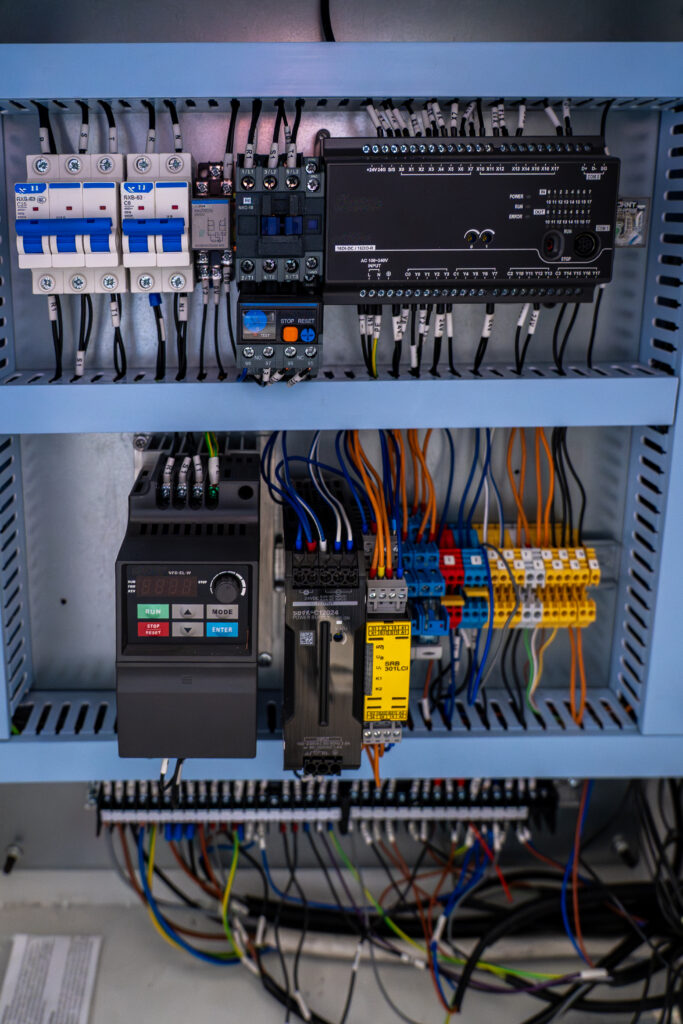
A Programmable Logic Controller (PLC) is a digital computing device designed to control automation processes. PLCs receive signals from various sensors and devices, process them according to programmed instructions, and then send the appropriate control signals to actuators. The key components of a PLC are:
- Processor
- Input/Output (I/O) modules
- Memory
- Communication interface
PLC Programming Languages
PLC programming can be carried out in several languages, each with its own advantages and specific applications. Below is an overview of the most common PLC programming languages:
- Ladder Diagram (LD): The best-known and most widely used language, resembling electrical schematics. It is ideal for electricians and technicians. Ladder Diagram is clear and intuitive, which makes it easier to diagnose and troubleshoot industrial automation systems.
- Structured Text (ST): A high-level programming language similar to PASCAL. It is used for more complex calculations and logic. Structured Text makes it easier to implement complex algorithms and mathematical operations.
- Function Block Diagram (FBD): A graphical language that enables programming with function blocks. It is popular in process applications. FBD allows programs to be created quickly by using ready-made function blocks.
- Instruction List (IL): A low-level programming language similar to assembly language. It is used in systems that require maximum performance. Instruction List is more complex, but it allows precise control over the process.
- Sequential Function Chart (SFC): A graphical language used for programming sequential processes. It is practical in systems with multiple stages. SFC is ideal for managing sequences of operations such as production processes.
- Structured Control Language (SCL): A high-level programming language that extends Structured Text. SCL is used mainly in the Siemens environment and enables more advanced PLC programming thanks to the language’s extended capabilities.
- CODESYS: A universal PLC development environment that supports many different programming languages and hardware platforms. CODESYS enables programming in various languages compliant with IEC 61131-3, making it a highly flexible tool for engineers.
| Programming Language | Description | Application | Advantages | Disadvantages |
|---|---|---|---|---|
| Ladder Diagram (LD) | Ladder logic resembling electrical circuits | Basic applications, easy for electricians | Intuitive, easy to debug | Limited logic complexity |
| Structured Text (ST) | High-level language similar to PASCAL | Complex calculations and logic | Flexible, easy for programmers to understand | Less visual, more difficult for beginners |
| Function Block Diagram (FBD) | Graphical language using function blocks | Process applications | Fast program creation, ready-made function blocks | May be less readable in large projects |
| Instruction List (IL) | Low-level language similar to assembly language | High-performance systems | Precise control over the process | Harder to learn and debug |
| Sequential Function Chart (SFC) | Graphical language for programming sequences | Sequential production processes | Clear stage management | Can become complex in complicated processes |
PLC Applications in Different Industries
PLC programming is widely used across different industrial sectors:
- Automotive: Control of assembly lines and management of welding and paint robots. PLCs are essential for automating vehicle production processes, where precision and reliability are critical in the automotive industry.
- FMCG (Fast-Moving Consumer Goods): Automation of packaging lines and control of production and warehouse processes. In the FMCG industry, speed and efficiency are crucial, and PLC programming helps achieve these goals by optimizing production processes.
- Heavy industry: Control of metallurgical processes and operation of large machines and material handling systems. In heavy industry, PLC programming is used to manage complex processes and support safe operation.
- Pharmaceuticals: Precise control of drug manufacturing processes, quality control, packaging, and distribution. In the pharmaceutical industry, PLCs are used to maintain high quality standards and regulatory compliance, such as GMP.
PLC Programming and Machine Safety
PLC programming plays a key role in ensuring machine safety for industrial equipment and machinery. In industrial automation, safety is a priority, and compliance with regulations and standards is essential. A key part of ensuring machine safety is meeting the requirements set out in the Machinery Directive 2006/42/EC, which defines the basic requirements for the design and construction of machinery to ensure safe use.
The Directive requires machinery to be designed and built in a way that eliminates the risk of accidents. This also includes implementing safety systems that can be managed by PLC controllers. An important aspect is risk analysis according to EN ISO 12100, which sets out the principles for hazard identification, risk assessment, and risk reduction.
Harmonized standards, such as EN ISO 13849-1 and EN 62061, provide guidance for designing and implementing safety systems. Safety controllers, which are a special type of PLC, are used to monitor and control safety functions. They offer higher reliability and are designed to ensure the machine reaches a safe stop in the event of a failure.
Safety systems include various components such as safety sensors, emergency stop devices, light curtains, and safety switch modules. All of these elements work together with safety controllers to monitor and control machinery in accordance with the requirements of the Machinery Directive 2006/42/EC and the relevant standards.
In the context of PLC programming, integrating safety functions means engineers must understand specific safety requirements and apply appropriate programming and testing techniques to ensure the systems comply with regulations. Implementing safety measures in line with standards and directives not only ensures legal compliance, but also protects workers and equipment, contributing to a safer and more efficient working environment. When designing safety-related control functions, it is also important to consider the safety of control systems under EN ISO 13849-1 and, where applicable, EN 62061 and the SIL level in machine safety.
PLC programming is closely integrated with SCADA (Supervisory Control and Data Acquisition) systems, which are used to monitor and control industrial processes on a large scale. SCADA systems collect data from PLCs and other devices, allowing operators to oversee the entire production infrastructure. Integrating PLC programming with SCADA enables seamless real-time data management, allowing rapid response to any irregularities and optimization of production processes.
Advantages and Disadvantages of Different PLC Types
Depending on the specific application requirements, different types of PLCs can be selected:
- Compact PLCs: All modules are integrated into a single device. Ideal for smaller applications.
- Advantages: Easy installation, lower cost.
- Disadvantages: Less flexibility and scalability.
- Modular PLCs: Consist of separate modules that can be tailored to the application’s requirements.
- Advantages: High flexibility and scalability.
- Disadvantages: Higher initial cost and more complex installation.
- Rack-mounted PLCs: Modules installed in dedicated cabinets, intended for large and complex systems.
- Advantages: Ability to handle a very large number of inputs/outputs and high reliability.
- Disadvantages: Highest cost and a large footprint.
PLC Programming: Core Tools from Siemens and Allen Bradley
In PLC programming, the tools used to develop and manage code are just as important as the programming languages themselves. Two of the best-known brands in the PLC field are Siemens and Allen Bradley.
Siemens
- TIA Portal (Totally Integrated Automation Portal): This is Siemens’ comprehensive engineering environment, integrating all the tools needed for PLC programming, configuration, and diagnostics in industrial automation systems. TIA Portal supports various IEC 61131-3 programming languages, including Ladder Diagram (LD), Function Block Diagram (FBD), Structured Text (ST), Instruction List (IL), and Sequential Function Chart (SFC).
- Advantages: All tools integrated in one environment, an intuitive user interface, and broad support for multiple programming languages.
- Disadvantages: High licensing cost and advanced knowledge required to make full use of its capabilities.
- SIMATIC Step 7: A programming tool for Siemens S7 series controllers. Step 7 offers advanced PLC programming, diagnostics, and maintenance features, enabling the development of complex automation applications.
- Advantages: Extensive programming capabilities and compatibility with many Siemens controllers.
- Disadvantages: A steep learning curve and higher cost compared with other tools.
Allen Bradley
- RSLogix 5000/Studio 5000: RSLogix 5000 (now known as Studio 5000) is an advanced PLC programming tool from Allen Bradley. It supports IEC 61131-3 programming languages such as Ladder Diagram (LD), Function Block Diagram (FBD), Structured Text (ST), and Sequential Function Chart (SFC). Studio 5000 is used mainly for programming ControlLogix and CompactLogix series controllers.
- Advantages: Intuitive user interface and advanced diagnostic and simulation features.
- Disadvantages: High licensing cost and the need for specialist knowledge.
- RSLogix 500: A tool for programming older Allen Bradley SLC 500 and MicroLogix controllers. RSLogix 500 provides basic PLC programming and diagnostics functions, making it suitable for less complex applications.
- Advantages: Easy to use and lower cost compared with Studio 5000.
- Disadvantages: Limited functionality compared with more advanced tools and no support for the latest controllers.
The Future of PLC Technology
PLC technology continues to evolve, bringing new functions and capabilities. Key future trends include integration with the Internet of Things (IoT), cybersecurity, artificial intelligence (AI), and advanced data analytics. PLC programming is expected to become increasingly sophisticated, enabling even greater automation and optimization of industrial processes in line with the principles of Industry 4.0. In this context, support from a safe software house for industry may be especially relevant where IT/OT integration and secure software development are involved.
PLC Programming: Common Problems and Solutions
Various issues can arise during PLC programming, including coding errors, communication problems, and hardware failures. The most common problems and their solutions include:
- Code errors: Regular code testing and debugging.
- Communication problems: Checking network configuration and verifying correct wiring.
- Hardware failures: Regular maintenance and replacement of worn components.
Best Practices in PLC Programming
To create efficient and reliable PLC programs, it is worth following best practices such as:
- Code modularity: Writing code in modules to make maintenance and modification easier.
- Documentation: Detailed code documentation that makes the program easier to understand and update in the future. Well-documented code also supports compliance with the requirements of the Machinery Directive 2006/42/EC.
- Testing: Regularly testing the code under different operating conditions.
- Safety: Implementing security measures such as passwords and data encryption. Ensuring compliance with electromagnetic compatibility requirements and the Low Voltage Directive. For machine control systems, it is also important to consider safety of control systems under EN ISO 13849-1.
In the context of PLC programming, the machine’s operating instructions should include detailed information on how the program works so that users can fully understand its operation and use the equipment safely and effectively. The key elements that should be included in the operating instructions are:
- Description of software functions:
- A detailed description of each PLC program function.
- An explanation of the control logic and operating sequence.
- Sequence diagrams:
- A graphical representation of operating sequences (sequence diagrams) showing the order of operations and the conditions under which each operation is performed.
- Sequence diagrams should be clearly described and easy to understand so that the user can quickly identify process stages and potential points of failure.
- Diagnostic instructions:
- A description of the diagnostic procedures available in the PLC program.
- Methods for identifying and interpreting errors, along with their possible causes.
- Maintenance and repair procedures:
- Instructions for regular system maintenance to ensure reliability and performance.
- Step-by-step procedures for repairing and replacing components related to the PLC program.
Technical documentation should also include detailed information on:
- Electrical diagrams: showing the connections of all PLC system components.
- Code and program listings: including the full source code and comments explaining how individual sections of the code work.
- Configuration files: required for correct PLC system operation.
- Testing and validation procedures: to ensure that the PLC program operates as intended and meets safety requirements.
Accurate and well-structured technical documentation, including sequence diagrams and detailed operating instructions, is essential to ensure safe machine operation, compliance with standards, and easier future modifications and troubleshooting. Depending on the scope of the project, this documentation may also support activities related to CE certification of machinery, machine upgrades, or adapting machines to minimum requirements.
PLC Programming: Educational Resources and Tools
For engineers and automation specialists looking to expand their knowledge of PLC programming, numerous educational resources are available:
- Online courses: Platforms such as Coursera, Udemy, and edX offer courses in PLC programming.
- Textbooks and books
- Simulation software: Tools such as Siemens’ TIA Portal or Rockwell Automation’s RSLogix make it possible to learn PLC programming and test code in a virtual environment.
PLC programming is a key part of modern industrial automation and is used across many industries. Understanding the core concepts, programming languages, and best practices enables engineers and automation specialists to create efficient, reliable, and safe systems. As technology continues to advance, PLC programming will play an increasingly important role in industrial process automation, helping improve efficiency and reduce production costs. In broader implementation projects, these activities may also involve support from a design office or apply to sectors such as the electronics industry and semiconductors.
PLC programming – introduction
A Programmable Logic Controller (PLC) is a digital computer device designed to control automation processes. It receives signals from sensors, processes them according to the program, and sends control signals to actuators.
The article identifies the processor, input/output (I/O) modules, memory, and the communication interface. These components enable signal acquisition, execution of control logic, and communication with the surrounding environment.
The following were listed, among others: Ladder Diagram (LD), Structured Text (ST), Function Block Diagram (FBD), Instruction List (IL), and Sequential Function Chart (SFC), as well as SCL and the CODESYS environment. The choice of language depends on the type of application, the complexity of the logic, and the team’s preferences.
PLCs are used, among other things, in automotive manufacturing (assembly lines, robots), FMCG (packaging lines), heavy industry (metallurgical processes, material handling), and pharmaceuticals (drug manufacturing, quality control, and packaging). Their use is driven by the need for reliable, repeatable process control.
PLC programming supports the implementation of safety functions and compliance with the requirements of the Machinery Directive 2006/42/EC and risk assessment in accordance with EN ISO 12100:2012. Safety systems also use safety controllers, designed to ensure the machine stops safely in the event of a failure.