
Key takeaways:
The article explains the role of the emergency stop function in machine safety, how it works, and examples of emergency situations. It emphasizes that the E-stop complements other protective measures and should comply with the requirements of the relevant standards.
- The emergency stop function (E-stop) enables the machine to be stopped immediately in a hazardous situation.
- Its purpose is to protect operators’ lives and health and to reduce the risk of equipment damage.
- It operates, among other things, by cutting power to the drives; stop categories 0, 1, and 2 are described (2 is not included in EN ISO 13850)
- It must be easily accessible, intuitive, and take priority over other functions, interrupting current operations.
- Design and implementation should take into account the risk assessment in accordance with EN ISO 12100 and the requirements of EN ISO 13850
In today’s industrial environment, the safety of workers and machinery is a top priority. The emergency stop function plays a key role in ensuring that safety. It is a system that allows a machine to be stopped immediately in a hazardous situation, protecting operators’ health and lives while minimizing the risk of equipment damage. In this article, we explain what the emergency stop function is, why it matters in industrial automation, which standards and regulations govern it, and how it is designed and integrated into modern automation systems.
What is the emergency stop function?
Definition and purpose of the emergency stop function
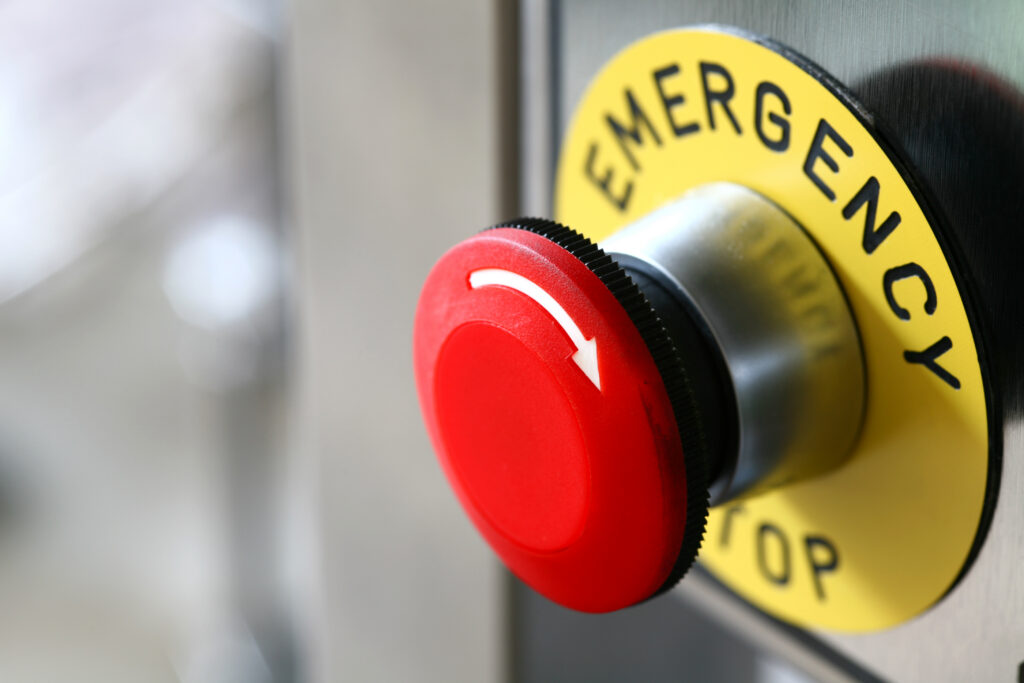
The emergency stop function, also known as an E-stop, is a key safety mechanism used in industrial machinery to stop the machine immediately in hazardous situations. Its purpose is to protect operators’ health and lives and prevent machine damage. The emergency stop function must be easy to access and intuitive to use so that it can be activated quickly in an emergency.
The emergency stop function is an important part of machine safety systems, providing an additional layer of protection if other hazard prevention measures fail. It is a mechanism that should be present at every workstation where hazardous situations may arise.
Operating principles
The emergency stop function works by cutting power to the machine’s drive elements, causing it to stop immediately. Depending on the machine and the production process, this function may operate according to different stop categories:
- Category 0: Immediate stopping by cutting power to the machine’s drive elements. This is the most direct form of stopping and eliminates the risk of further machine movement. This category is recommended where response time is critical and an immediate stop is necessary to ensure safety.
- Category 1: A controlled stop in which the machine first stops in a controlled manner and only then is the power removed. This type of stop is used where an immediate stop could create additional hazards or damage. Once the machine has stopped, the power is cut off, ensuring a safe state.
- Category 2: Stopping without cutting power to the drive elements. In this category, the machine stops in a controlled manner, but power is maintained, allowing operation to resume immediately once the cause of the stop has been removed. This category is used where it is necessary to maintain full control of the machine during stopping. (this category is not covered by EN ISO 13850)
Each of these categories has specific applications depending on the type of machine, the production process, and the safety requirements. Selecting the right stop category is essential to achieving the highest possible level of safety and minimizing the risks associated with machine operation.
The emergency stop function must always be available and effective, regardless of the state of the machine or process line. It must take priority over all other machine functions and actions, which means that activating it interrupts all ongoing operations.
Examples of emergency situations
Emergency situations can take many forms and may result from various causes, such as:
- Human contact with moving machine parts: If an operator accidentally enters the danger zone, stopping the machine immediately can prevent serious injury.
- Mechanical or electrical failure: Damage to a critical machine component, such as a broken shaft or an electrical short circuit, can lead to uncontrolled movement or fire.
- Sudden changes in operating conditions: An increase in temperature or pressure, or a leak of hazardous substances, may require the machine to be stopped immediately to prevent a more serious incident.
- Errors in the control software: Problems with the control system can lead to unexpected machine movements, creating a direct hazard to the operator and the surrounding area.
Importance in the context of workplace safety
Workplace safety in industry is an absolute priority. Implementing the emergency stop function in production machinery significantly improves safety in the workplace. This function enables a fast and effective response to unforeseen situations, minimizing the risk of accidents and damage.
In the context of production automation and industrial automation, the emergency stop function is a fundamental part of safety management systems. It enables operators to work under safer conditions, knowing they can stop the machine immediately whenever necessary.
The emergency stop function is also a key element of the risk assessment process under EN ISO 12100, which forms the basis for designing safe machinery. This standard emphasizes that the emergency stop function must not be treated as the only protective measure, but as a supplement to other technical protective measures and safety systems.
Standards and regulations governing the emergency stop function
Implementation of the emergency stop function must comply with the relevant standards and regulations. One of the most important standards in this area is EN ISO 13850, which sets out the requirements for designing and implementing the emergency stop function in machinery. Under this standard, the emergency stop function must be available in all machine operating modes without impairing other protective functions.
Other important standards and regulations include:
- Machinery Directive 2006/42/EC: This directive requires manufacturers to ensure that their machines are safe and comply with specified requirements, including those relating to the emergency stop function.
- EN ISO 12100: This standard focuses on the general principles for designing safe machinery, including risk analysis and requirements for protective measures.
- IEC 60947-5-5: This standard specifies the requirements for electrical devices used in the emergency stop function.
The emergency stop function is an integral part of CE certification of machinery, which confirms that a machine complies with EU directive requirements. To obtain the CE mark, a machine must undergo rigorous testing and safety audits, including an assessment of the effectiveness of the emergency stop function.
The importance of the emergency stop function in industrial automation
Application examples
The emergency stop function is widely used across many industries where reliability and safety are critical. Examples include:
- Automotive industry: Automated assembly lines and industrial robots require immediate stopping when any abnormality is detected to prevent accidents and damage.
- Food industry: Packaging, filling, and food processing machines must be stopped quickly if there is a contamination risk to ensure product safety.
- Chemical industry: Chemical reactors and other equipment may require immediate shutdown in the event of leaks or uncontrolled chemical reactions to prevent serious accidents.
- Energy industry: Wind turbines, generators, and other equipment must be fitted with an emergency stop function to protect against damage in the event of a failure.
Benefits for safety and production efficiency
Implementing the emergency stop function brings many benefits from both a safety and production efficiency perspective. These benefits include:
- Improved workplace safety: The emergency stop function allows an immediate response to unforeseen situations, minimizing the risk of accidents and injuries.
- Reduced material losses: Quickly stopping a machine in the event of a failure helps prevent more serious damage, reducing repair costs and production downtime.
- Improved production efficiency: Minimizing downtime and restoring normal operating conditions quickly after a failure increases production continuity and reduces production losses.
- Meeting legal requirements: Compliance with machinery safety standards and regulations is not only a legal obligation, but also part of building the company’s reputation as a responsible manufacturer.
Standards and regulations governing the emergency stop function
EN ISO 13850 and other key standards
EN ISO 13850 is the core standard defining the design principles and requirements for the emergency stop function. This standard covers:
- Design and placement of emergency stop devices: These devices must be easily accessible and clearly visible to the operator so they can be used quickly in an emergency.
- Electrical and mechanical safety requirements: Emergency stop devices must meet reliability and safety requirements, including testing their effectiveness under different conditions.
- Testing and certification of devices: The devices must undergo regular testing and certification to ensure compliance with standards and regulations.
Requirements of the Machinery Directive 2006/42/EC
The Machinery Directive 2006/42/EC requires manufacturers to ensure that their machines comply with specified safety requirements. These requirements include:
- Machine design and construction: Machines must be designed and built to minimize the risk of accidents and hazards.
- Risk assessment: The manufacturer must carry out a risk analysis according to EN ISO 12100 for each machine, identifying potential hazards and implementing preventive measures.
- CE marking of machines: Machines must bear the CE mark, which confirms compliance with the requirements of the directive and allows them to be legally placed on the EU market.
Designing the emergency stop function
Design requirements and principles
Designing the emergency stop function requires consideration of many factors, such as the type of machine, the specifics of the production process, and operator safety requirements. The key design principles include:
- Accessibility and visibility: Emergency stop devices must be located in places that are easy to access, clearly visible, and intuitive for the operator.
- Reliability: The devices must be reliable and effective under all conditions, which means they must operate even in extreme environmental conditions.
- Ease of use: The emergency stop function must be easy to use, meaning its activation should be intuitive and require minimal force.
Areas of effect
The areas of effect of emergency stop devices must be clearly defined and properly marked. It is important that operators have easy access to these devices and can identify them quickly. Key aspects include:
- Physical machine layout: Emergency stop devices must be placed where operators can easily find and use them.
- Visibility and identification: The devices must be clearly visible and marked so that operators can quickly identify and activate them when needed.
- Safety of the area of effect: The area of effect of the devices must be safe for the operator and must not create additional hazards during activation.
Integration of the emergency stop function in automation systems
Integration with SCADA and PLC
Integrating the emergency stop function into SCADA (Supervisory Control and Data Acquisition) and PLC (Programmable Logic Controller) systems is essential for effective production process management. SCADA and PLC systems enable real-time monitoring of machine status and a rapid response to any irregularities.
Examples of integration in real-world systems
Examples of integrating the emergency stop function in real industrial automation systems include:
- Production line monitoring and control systems: The emergency stop function is triggered automatically when an anomaly is detected, allowing the machine to be stopped quickly and effectively.
- Advanced diagnostic systems: These systems analyze sensor data and predict potential failures, enabling preventive action to be taken at an early stage.
- Integration with safety systems: The emergency stop function can be integrated with other safety systems, such as fire protection systems or access control systems, which increases the overall level of safety in the production plant.
Safety audit and CE certification
The importance of safety audits
A safety audit is an essential part of the process of ensuring that machines comply with legal requirements and standards. Audits make it possible to identify potential hazards and assess the effectiveness of existing protective measures. Regular safety audits are key to maintaining a high level of safety in the production plant and ensuring compliance with applicable regulations.
The CE certification process for machinery
CE certification of machinery includes:
- Conducting a risk analysis: A risk analysis in accordance with EN ISO 12100:2012 is a key part of the certification process. It makes it possible to identify and assess hazards associated with the machine and to define appropriate preventive measures.
- Meeting technical requirements: The machine must meet the technical requirements set out in the relevant harmonized standards, covering, among other things, design, electrical safety, mechanical safety, and hydraulic safety.
- Preparing and submitting the EC Declaration of Conformity: The manufacturer must prepare the EC Declaration of Conformity, confirming that the machine meets all applicable EU directive requirements. This declaration must be signed by an authorized person and include all necessary information, such as the machine’s technical data, serial number, production date, etc.
The future of the emergency stop function in the context of Industry 4.0
New technologies and innovations
Industry 4.0 introduces new technologies with the potential to transform the emergency stop function. Examples of such innovations include:
- Artificial intelligence: Using artificial intelligence to analyze sensor data and predict failures can significantly improve the effectiveness of the emergency stop function. AI can analyze data in real time and make decisions about stopping the machine before a failure occurs.
- Internet of Things (IoT): Integrating the emergency stop function with IoT systems enables remote machine monitoring and management. IoT devices can send data to a central system, which analyzes it and makes emergency stop decisions when irregularities are detected.
- Augmented reality (AR): AR technology can be used to train operators in the use of the emergency stop function. Operators can use interactive simulations to better understand how the emergency stop function works and how to activate it in emergency situations.
Examples of applications in Industry 4.0
In the context of Industry 4.0, the emergency stop function can be used in various modern solutions, such as:
- Smart factories: In smart factories, autonomous systems monitor and manage machines. The emergency stop function can be triggered automatically by AI systems that analyze sensor data and detect irregularities.
- Robotic systems: In robotic systems, the emergency stop function is essential to ensure safe human-robot collaboration. Robots equipped with advanced sensors can stop their movements immediately when a hazard is detected.
- Automated warehouse systems: In automated warehouses, the emergency stop function can be used to stop mobile shelving and transport vehicles when obstacles or other hazards are detected.
Key takeaways
The emergency stop function is an indispensable part of modern industrial automation systems. Its proper design and integration with control systems are crucial to ensuring workplace safety and production efficiency. This function enables an immediate response to emergency situations, minimizing the risk of accidents and machine damage.
Guidance for engineers and designers
For engineers and designers, it is important to:
- Ensure easy access to and visibility of emergency stop devices: These devices must be placed in strategic locations and be clearly visible and intuitive for operators to use.
- Carry out regular safety audits: Audits help identify potential hazards and assess the effectiveness of existing protective measures.
- Update systems in line with the latest standards and regulations: Regular updates ensure compliance with applicable regulations and standards, which is essential for maintaining a high level of safety.
- Implement modern technologies and innovations: New technologies such as AI, IoT, and AR can significantly improve the effectiveness of the emergency stop function and enhance the overall level of safety in the production facility.
In summary, the emergency stop function plays a key role in ensuring the safety of machines and operators in industry. Its effective implementation and integration with modern automation systems are the foundation of a safe and efficient working environment.
Emergency stop function: machinery safety
This is a safety mechanism that allows the machine to be stopped immediately in an emergency. Its purpose is to protect operators’ health and lives and reduce the risk of equipment damage.
It works by interrupting machine operation, most often by cutting power to the drive components, which brings the motion to a stop. This function must be easily accessible, intuitive, and take priority over the machine’s other actions.
This includes category 0 (immediate power removal), category 1 (controlled stop followed by power removal), and category 2 (controlled stop without power removal). The text states that category 2 is not covered by EN ISO 13850.
Design requirements for the emergency stop function are set out in EN ISO 13850. The article also identifies the Machinery Directive 2006/42/EC and EN ISO 12100 as important in the context of safety and risk assessment.
Where a hazard arises, for example human contact with moving parts, a mechanical or electrical failure, sudden dangerous changes in operating conditions, or control software errors. It is intended to provide an additional layer of protection when other measures fail.