
Key takeaways:
The text discusses the definition, types, organization, and advantages and disadvantages of assembly lines, and also points to Industry 4.0, IoT, and Kaizen/JIT/Poka-Yoke trends.
- Assembly lines divide product manufacturing into a sequence of steps carried out at separate workstations
- The types of line described are: conventional, automated, modular, lean, and specialist (assembly/welding, painting, electronics).
- In production organization, a distinction is made between line production (continuous flow) and cellular production (workshops, greater flexibility).
- The benefits include higher productivity, standardization, improved quality, and potentially greater safety through automation
- The challenges include high upfront costs and limited flexibility, mitigated by modular approaches, lean principles, and SMED.
Assembly lines are at the heart of modern industrial manufacturing and have transformed the way products are produced on a large scale. Since Henry Ford introduced them, assembly lines have become a symbol of efficiency and standardization across many industries. In this article, we discuss the different types of assembly lines, their advantages, challenges, and the current trends shaping the future of manufacturing.
What are assembly lines?
Assembly lines are organized production systems that divide the manufacturing process into a sequence of steps. Each step is performed at a separate workstation, enabling efficient, high-speed production at scale. These systems are widely used across many industries, from automotive and electronics to food manufacturing.
Assembly lines – types
1. Conventional Lines
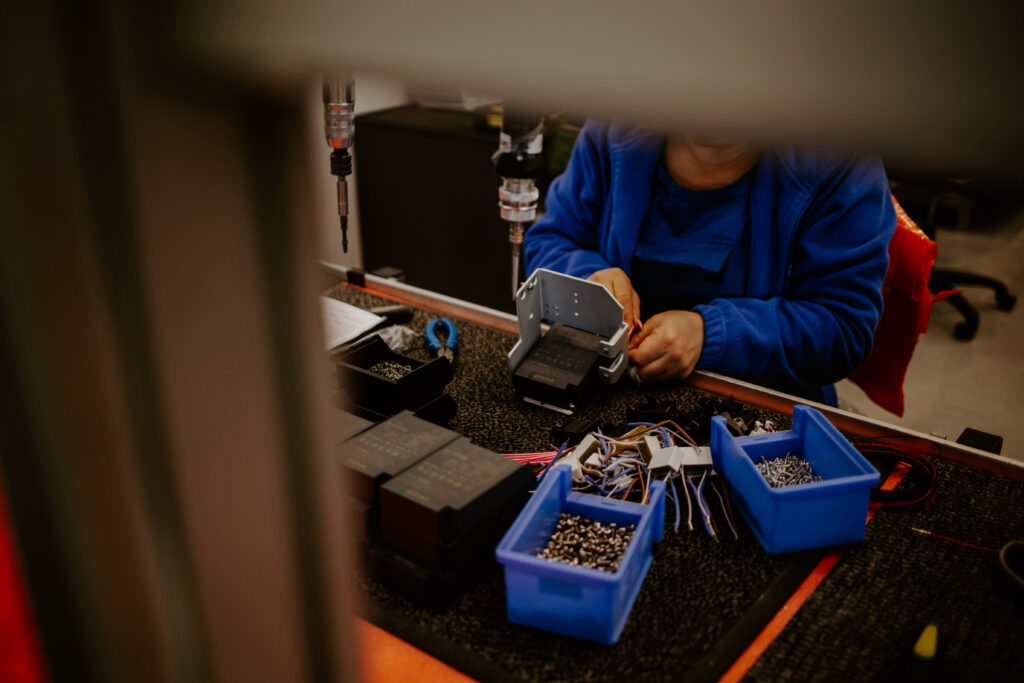
These are traditional production lines in which each operator performs a specific task. They are used mainly for high-volume production of identical products, such as cars, household appliances, or electronics. Conventional assembly lines offer high throughput, but they may be less flexible when new products are introduced.
2. Automated Lines
These lines use industrial robots and automation to carry out most assembly processes, increasing precision and reducing human error. One example is vehicle assembly, where different robots can install different parts, such as seats or windshields. Production automation improves efficiency, but it also involves high initial costs.
3. Modular Lines
These are flexible systems that can be expanded as production grows. They allow rapid adaptation to changing market conditions and production needs. They can be used to assemble different components, which are then combined into a single finished product. Their modular design also makes it easier to integrate with other systems, such as mobile robots and lean systems.
4. Lean Lines
Based on lean manufacturing principles, these lines are designed to minimize waste and optimize production processes. They use the One-Piece-Flow concept, which helps eliminate bottlenecks in production. Lean lines are particularly effective in environments where a rapid response to market changes is essential, and SMED further supports faster changeovers.
5. Screwdriving and Welding Lines
These lines are specifically designed to assemble components using screwdriving, fastening, or welding. They can be used to manufacture metal parts, electronics, mechanical equipment, and other products that require precise joining of components.
6. Painting and Finishing Lines
These lines are used for applying paint coatings and carrying out other finishing processes. They are common in the automotive industry, furniture manufacturing, and household appliance production. Such processes provide an attractive appearance and protect products from external factors.
7. Electronics Assembly Lines
These lines are specifically designed for assembling electronic components such as integrated circuits, printed circuit boards (PCBs), and other subassemblies. They may include soldering, testing, and packaging of electronic products.
Assembly lines: production organization
Flow Production
In flow production, products are manufactured continuously, moving from one station to the next. This approach is characterized by short cycle times, minimal storage of semi-finished goods, and high efficiency. It is used mainly in mass production, such as in the automotive and electronics industries.
Cellular Production
In cellular production, work takes place in separate production areas, with each area responsible for a specific stage of the process. This model is characterized by high flexibility, the ability to adapt to individual orders, and suitability for low-volume or one-off production. It is often used in specialized manufacturing, such as tools, machinery, and furniture.
Assembly lines: advantages and challenges
Advantages:
- Efficiency and Productivity: Assembly lines enable fast, high-volume production, which lowers unit costs. A good example is their widespread use in car manufacturing, where each part is added in sequence, speeding up the entire process.
- Improved Quality: By standardizing processes, products become more consistent and better aligned with quality requirements, reducing the risk of errors and improving overall production quality.
- Workplace Safety: Automating production processes reduces the need for people to perform hazardous and repetitive tasks, lowering the risk of accidents. Employees can be reassigned to more advanced work, which improves both job satisfaction and safety.
Challenges:
- Initial Costs: Investment in assembly lines, especially automated ones, is substantial. It requires advanced equipment and staff training. This is particularly important when adapting production to new technologies and automation.
- Flexibility: Traditional assembly lines may struggle to adapt to new products or changes in the production process, which can require downtime and line modifications. However, modern modular and lean lines can respond more quickly to market changes, especially when supported by solutions for rapid changeovers such as SMED.
Assembly Lines: Current Trends
Modern assembly lines increasingly rely on advanced technologies such as artificial intelligence and robotics to improve production efficiency and precision. Industry 4.0 and concepts such as the Internet of Things (IoT) make it possible to continuously monitor and optimize production processes, leading to better quality control and less waste.
Kaizen and Just-in-Time: Kaizen, the philosophy of continuous improvement, is a key element of modern assembly lines. Techniques such as Just-in-Time (JIT) help reduce inventory and eliminate waste, which in turn increases production efficiency. Poka-Yoke, another Kaizen technique, focuses on error prevention, contributing to higher production quality.
Assembly Lines: Industrial Automation and SCADA
Industrial automation is a field focused on automating production processes using technologies such as SCADA (Supervisory Control and Data Acquisition) systems. SCADA enables real-time monitoring and control of industrial processes, allowing a rapid response to any irregularities. With SCADA, assembly lines can also incorporate safety functions that improve efficiency and reduce the risk of failures.
Machine Safety
Machine safety is a key aspect of every factory. CE certification for machinery and bringing machines into line with minimum requirements are essential to ensure that machines meet all safety standards. The Machinery Directive 2006/42/EC and the Machinery Regulation 2023/1230 govern machine safety rules in the EU. When planning or launching a new line, it is also important to understand the responsibilities of the machine manufacturer. Risk assessment according to EN ISO 12100:2012 and CE marking are indispensable parts of this process.
Industry 4.0
Industry 4.0 is a concept that combines modern technologies such as the Internet of Things (IoT), big data, and artificial intelligence to create smart factories. In such factories, production lines are integrated with advanced monitoring and data analysis systems, enabling real-time optimization of production processes.
As part of Industry 4.0, engineering offices and engineering outsourcing are becoming key elements in the design and implementation of modern production solutions. Machine design and industrial machine building now require advanced technologies to be taken into account, as well as compliance with harmonized standards.
Assembly Lines: Use of Advanced Technologies
An industrial automation integrator plays a key role in combining different systems and technologies into one cohesive whole. Modern assembly lines use SCADA systems, PLCs, as well as advanced robots capable of performing complex tasks with high precision. The automation of production processes helps increase efficiency and improve product quality.
Design for Assembly and Design for Manufacturing are design approaches that take ease of assembly and production into account at the product design stage. As a result, the manufacturing process becomes more efficient and less prone to errors. Project management in such environments requires advanced coordination and planning to ensure compliance with customer requirements and legal regulations, including technical documentation obligations.
Certification and Standards
CE certification for machinery and CE marking are essential for machines placed on the European market. They ensure that machines meet all required safety and quality standards. Depending on the equipment and its intended use, the conformity assessment path must also be selected correctly. The Pressure Equipment Directive, the Low Voltage Directive, and regulations on electromagnetic compatibility also govern the safety and functional aspects of specialist machinery.
The Future of Assembly Lines
In the future, we can expect even deeper integration of advanced technologies with assembly lines. The development of robotics, artificial intelligence, and autonomous systems will continue to shape the manufacturing industry, leading to even greater efficiency and adaptability.
Assembly lines are a key part of modern manufacturing processes, offering many benefits while also presenting companies with challenges related to investment and flexibility. Their development and adaptation to new technologies underline their strategic importance to industry.
In the future, the integration of advanced technologies such as industrial robots, industrial automation, and SCADA systems, together with Industry 4.0 concepts, will continue to shape the manufacturing landscape. For companies introducing new machinery or lines, issues related to placing machinery on the market, the EU Declaration of Conformity, and the CE nameplate will remain just as important as efficiency, precision, and safety in factories around the world.
Assembly lines
Assembly lines are organized production systems that divide product manufacturing into a sequence of steps. Each step is carried out at a separate workstation, which enables fast, large-scale production.
These include conventional, automated, modular, and lean lines, as well as specialist lines for screwdriving/welding, painting, and electronics assembly. They differ in their level of automation, flexibility, and intended application.
Flow production is continuous and involves moving the product between stations, which supports short cycle times and high throughput. Cellular production takes place in separate workshops, is more flexible, and is better suited to small batches or custom orders.
They increase efficiency and productivity, reduce unit costs, and improve quality through process standardization. Automation can also reduce the risk of accidents by eliminating hazardous and repetitive tasks performed by people.
The challenges are high upfront costs, especially for automated lines, and the limited flexibility of traditional solutions. Trends include the use of AI, robotics, Industry 4.0, and IoT, as well as Kaizen, Just-in-Time, and Poka-Yoke approaches, and process monitoring via SCADA.