
Key takeaways:
The article explains what FEM modal analysis provides, how it is performed via an eigenvalue solver, and how results guide vibration-resistant, safer designs.
- Modal analysis is an FEA method to find a structure’s natural frequencies and mode shapes to assess resonance risk.
- It does not predict response magnitude (displacements/stresses) under specific loads; it provides the “dynamic signature”.
- Engineers use results to avoid excitation frequencies and to target stiffening or damping in critical areas.
- FEM workflow: build geometry/mesh/materials/boundaries, then solve eigenvalue problem using mass and stiffness matrices.
- Model quality matters; poor constraints or connections can create artificial zero-frequency modes and mislead interpretation.
Modern mechanical design requires not only a standard strength analysis of components, but also consideration of dynamic effects. Vibrations can lead to failures, material fatigue, or excessive noise—so engineers use FEA calculations such as modal analysis to identify potential structural vibration issues already at the design stage and ensure safety. High-profile cases have shown that ignoring dynamics can be disastrous—the classic example is the collapse of the Tacoma Narrows Bridge in 1940 due to wind-induced resonance. In this article, we explain what FEA modal analysis involves, what information it provides to the designer, and how it helps in designing vibration-resistant structures. We will present the steps of such an analysis, explain when and why it is worth using, discuss its relationship with forced-vibration (harmonic) analyses, acoustics, and modal testing, and illustrate modern applications of this method across industries—from machinery and automotive to power engineering and electronics.
What is modal analysis, and what does it offer an engineer?
Modal analysis is a simulation of a structure’s inherent vibrations, used to determine its natural vibration frequencies (natural frequencies) and mode shapes. Put simply, it answers two key questions: at which frequencies the structure will resonate and what shapes it will take during those vibrations. It is worth noting that modal analysis does not directly indicate the magnitude of displacements or stresses under specific loads—it only provides data on the characteristic frequencies and vibration forms at which resonance may occur. For an engineer, this is extremely important information: it makes it possible to anticipate potential vibration issues and assess whether a given structure will tend to resonate under typical excitations (e.g., engine operation, wind, vehicle traffic, etc.).
Natural frequencies are the characteristic frequencies at which a system “prefers” to vibrate. Knowing them allows us to design structures so they do not coincide with external excitations (e.g., a machine’s rotational frequency, wind gusts, or ground vibrations during an earthquake). Mode shapes, in turn, show deformation patterns—that is, which parts of the structure move and how they move at a given natural frequency. By analyzing mode shapes, an engineer can identify critical areas of the structure that are most susceptible to vibration and take steps to stiffen them or add damping. The third key concept is damping—the mechanism by which vibration energy is dissipated. Although standard FEM modal analysis often assumes undamped vibration (damping = 0), an engineer can include material or structural damping to estimate how quickly vibrations will decay. An appropriate level of damping helps limit vibration amplitudes and prevent sustained oscillations.
In summary, modal analysis provides the designer with a structure’s “dynamic signature”—a set of natural frequencies and their corresponding mode shapes. On this basis, it is possible to assess the structure’s susceptibility to resonance and ensure that the designed machine or engineering structure will be safe and efficient in operation. It is the foundation for further dynamic analyses, ensuring that the design will meet vibration requirements.
How is an FEM modal analysis carried out?
A typical FEM modal analysis consists of several steps, carried out using Finite Element Method (FEM) software. Below we outline the main stages of such an analysis:
1. Model setup: geometry, mesh, and boundary conditions. The process starts by building an FEM model of the structure under analysis—capturing the geometry of the part or assembly, material properties (density, Young’s modulus, etc.), and boundary conditions (support method, restraints, etc.). It is essential to discretize the geometry properly (meshing) into finite elements and to define the connections between parts correctly. At this stage, the engineer focuses on model quality—accurately representing the real structure, because the credibility of the results depends on it. A good model means a suitably refined mesh in critical areas, correct material properties, and all relevant boundary conditions (e.g., bolted joints, supports) represented as close to reality as possible. It is also worth making sure the model has no “looseness”—poorly connected or unconstrained components can show up in modal analysis as artificial zero-frequency modes (i.e., free movement of disconnected parts). Checking whether the first natural modes correspond to the expected rigid-body motions of the entire structure (e.g., 6 rigid-body motions for a free body in space) helps verify that supports and connections have been defined correctly.
2. Solving the eigenvalue problem (modal solver). The main objective of modal analysis is to solve the eigenvalue problem for the structure’s equations of motion. Based on the model, the FEM program generates the global mass matrix and the structure’s stiffness matrix, and then solves the eigenvalue equation (K – λ M) φ = 0, where the solutions are pairs consisting of: eigenvalues λ (related to the natural frequencies ω, typically λ = ω²) and the corresponding eigenvectors φ (describing the mode shapes). In practice, the solver returns a list of the calculated natural frequencies (e.g., from the lowest upward) and a set of displacement vectors for each mode (which can be visualized as a mode shape). The engineer typically specifies in advance how many modes should be extracted, or up to what maximum frequency the calculations should be carried out. Typically, the first several modes are computed (e.g., 6–20) or all modes within the frequency range that is relevant from an operational standpoint. This way, the analysis focuses on those natural vibrations that may fall within the range of excitations acting on the structure.
3. Interpreting the results: natural frequencies and mode shapes. After the calculations, the engineer receives a set of results that must be interpreted. The first step is to review the natural frequency values—with particular attention paid to the lowest natural frequencies (because the lowest mode is often the easiest to excite and typically shows the largest amplitudes under forcing). The calculated frequencies are compared with the potential excitation frequencies the structure will be exposed to during operation. If any natural frequency lies close to an operating frequency (e.g., a machine’s rotational speed, a vehicle wheel frequency, the pulsation of the electrical grid, or the dominant component of ground vibration), this is a warning sign—a resonance risk. The second step is analysis of the natural mode shapes. By examining the deformations for successive modes, the engineer can assess which parts of the structure move the most in a given mode—e.g., whether it is overall bending, a local vibration of a skin plate, or vibration of a subassembly. This insight indicates where the structure is too flexible or prone to vibration. For example, a mode shape may reveal that a particular beam is deflecting laterally—suggesting the need to add transverse stiffeners. Or that a heavy component is vibrating independently of the rest—which may indicate insufficient mounting.
The results of a modal analysis—a set of natural frequencies and mode shapes—are then used to support design decisions. If any mode is potentially hazardous (e.g., its frequency coincides with an excitation, or we observe large deformations of critical components), the designer can modify the structure before it is built. Increasing stiffness (e.g., by using thicker sections or adding stiffening ribs), changing mass (adding weights, changing the material), or using vibration dampers are typical ways to shift natural frequencies or reduce vibration amplitudes. Modal analysis is often repeated iteratively after changes are introduced to confirm the effectiveness of these improvements. In this way, modal analysis becomes an integral part of the design cycle—already at the virtual stage, we eliminate weak points and ensure an adequate safety margin with respect to the structure’s dynamic behavior.
When and why is modal analysis used?
It is worth carrying out a modal analysis whenever a structure may be subjected to vibrations during operation, or when the consequences of a potential resonance could be hazardous. In practice, this applies to most engineering projects—from machines with rotating components to vehicles and electronic devices. Here are the key reasons and situations in which modal analysis is indispensable:
- Avoiding resonance and failures: The primary goal is to identify the frequencies at which a structure could enter resonance and to ensure that, under normal operating conditions, such coincidences will not occur. Resonance causes a rapid increase in vibration amplitude—then even small periodic forces can produce large displacements and stresses. This is a direct path to damage, fatigue cracking, and, in extreme cases, destruction of the machine or structure. With modal analysis, we can redesign the structure in advance or adjust the machine’s operating parameters to avoid hazardous resonance conditions. For example, if we know a given machine has a natural frequency at ~50 Hz, we can design the drive system so it does not excite vibrations at that frequency, or add dampers if 50 Hz cannot be avoided.
- Improved durability and reliability: Even if resonance does not immediately lead to a catastrophe, continuous vibration can cause accelerated wear of components (loosening of joints, material fatigue, bearing wear, etc.). Modal analysis makes it possible to identify potentially problematic vibration modes and optimize the design to reduce unwanted vibrations during operation. A robust device is not only one that can withstand static loads, but also one that does not vibrate excessively under dynamic loading. Manufacturing companies often require their products to pass rigorous vibration tests before they reach the market—modal simulation and related analyses help ensure that the design will survive these tests without damage.
- Comfort and noise (NVH aspects): In industries such as automotive or consumer electronics, it is not only about making sure the product “doesn’t fall apart”, but also about ensuring it operates quietly and feels comfortable for the user. Structural vibrations often translate into noise—for example, in a car, a vibrating body can radiate a booming sound into the cabin, and in household appliances, resonating sheet-metal panels can cause buzzing. Modal analysis makes it possible to design a structure so that critical vibration frequencies lie outside the range that is audible or perceptible to humans. This helps reduce the noise and vibrations experienced by users, improving product quality. Many companies use the term NVH (Noise, Vibration, Harshness) to describe issues related to noise and vibration—and modal simulation is a core tool in addressing these phenomena. For instance, car manufacturers analyze body vibration modes to avoid frequencies that cause cabin drone during engine operation. Stiffening sheet-metal sections or adding damping in areas responsible for so-called structure-borne noise can significantly improve a vehicle’s acoustic comfort.
- Standards and design procedure requirements: In some industries, modal analysis is explicitly required by standards or design guidelines. For example, in the previously mentioned oil and gas sector, API 610 sets criteria for separating natural frequencies from pump operating speeds.
In summary, we use modal analysis preventively at the design stage—to stop problems before they arise—and diagnostically for existing structures—to solve the puzzle of excessive vibration or noise by modifying the design. It is a versatile engineering tool that helps address vibration issues at every stage of a product’s or facility’s life cycle. The result is a safer, more durable, and often better-refined structure.
Modal analysis vs. forced vibration, harmonic analysis, and acoustics
Modal analysis on its own provides information about a structure’s dynamic properties, but to fully assess the actual vibration response, additional analyses are often performed using the modal results. Common extensions include harmonic analysis (frequency response to sinusoidal excitation), time-domain simulations of forced vibrations, and acoustic analyses. Below, we discuss how modal analysis relates to these topics:
Harmonic analysis and forced vibrations
Once the natural frequencies and mode shapes have been determined, the next step is often to check how the structure will behave under a specific dynamic excitation. A modal analysis may show, for example, that the structure has a critical natural mode at 80 Hz—but will it actually be damaged if a vibration at that frequency occurs in practice? Harmonic analysis answers this question by simulating the structure’s response to sinusoidal excitations with varying frequency. It uses the modal results—most FEM solvers apply so-called modal superposition, i.e., summing the contributions of individual natural vibration modes to the forced response. In other words, before we perform a harmonic analysis (or, more generally, a dynamic forced-response analysis), we must know the system’s modal parameters. The modal basis makes it possible to efficiently compute the response across many frequencies.
In practice, harmonic analysis involves, for example, applying a sinusoidal force with a specified amplitude and frequency to an FEA model, iteratively for successive frequencies across a given range (a so-called frequency sweep). The result is a frequency response characteristic—for instance, displacement or stress amplitudes as a function of excitation frequency. This makes it possible to identify resonant frequencies (where the amplitude plot peaks) and to assess the vibration level at resonance and away from it. If a resonance falls close to the operating frequency and the simulated stresses exceed the material’s fatigue limit, the design needs to be modified or damping applied, because over the long term it is at risk of cracking. This scenario occurs when the natural frequency cannot be easily shifted (e.g., due to design constraints)—in that case, forced-vibration simulation helps estimate the real risk. In one of the described cases, when the natural frequency was dangerously close to the excitation, engineers performed a harmonic analysis with applied periodic forces and compared the resulting stresses with the material’s fatigue strength; based on this, they concluded that the vibrations would not cause cracking, despite resonance, because the amplitude was relatively small. Of course, this is an exceptional situation—generally, we aim to design away from resonance so as not to risk operating at that point at all.
It is worth adding that harmonic analysis is only one type of forced-vibration analysis. Others include, for example, transient analysis (impulsive or, more generally, non-periodic excitation in the time domain) and spectral analysis (e.g., random vibrations with a specified frequency spectrum). In all of these cases, modal analysis is the starting point—the natural modes form the basis for calculating the dynamic response to any excitation. Without the system’s modal characteristics, it would be impossible to efficiently predict how a structure behaves under dynamic loading. It can therefore be said that modal analysis provides the information necessary for further vibration simulation of a structure under real-world conditions.
Link to acoustics (noise and vibration)
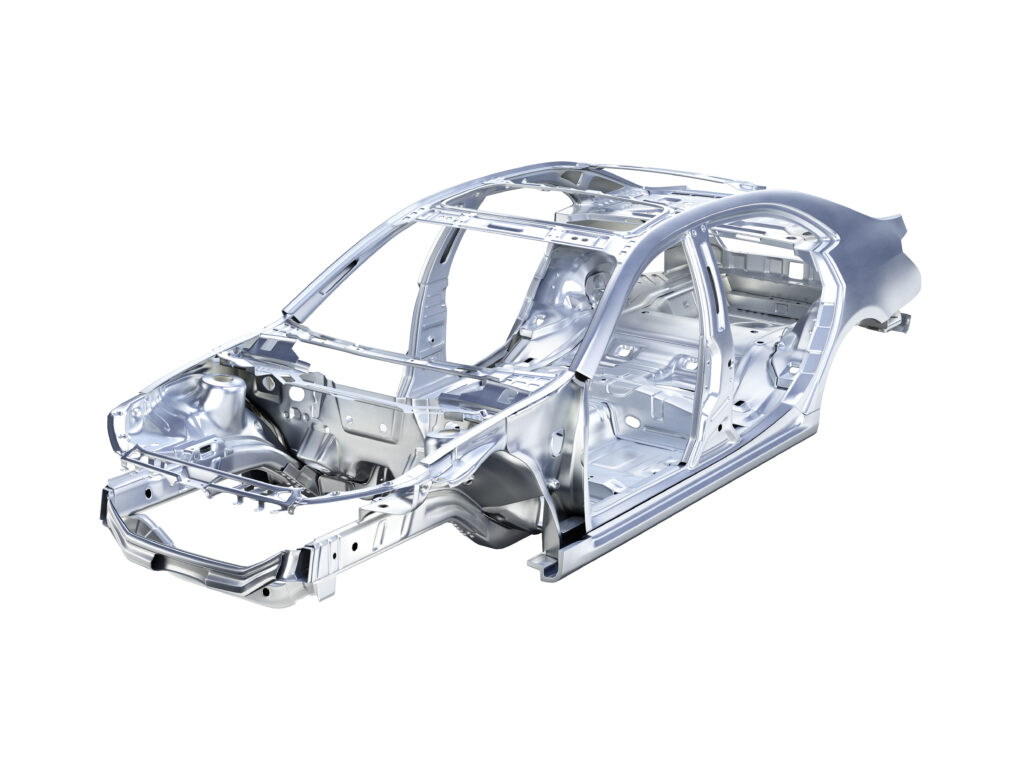
As mentioned, structural vibration often goes hand in hand with noise. Vibrating components emit sound waves (structure-borne noise), and in enclosed spaces (e.g., a vehicle interior or an electronic device enclosure) the acoustic waves themselves can form their own acoustic modes—i.e., air resonances inside the cavity. Modal analysis is highly important in acoustic and NVH-driven design. First, understanding a structure’s vibration modes makes it possible to identify the vibrations that lead to unwanted sound emission. Engineers can then modify the design to reduce the amplitudes of such vibrations (e.g., by adding reinforcements) and thereby reduce noise. For example, in one automotive project, body-in-white modes were analyzed and it was found that a low roof vibration mode caused booming that was audible to passengers. Adding extra roof reinforcement raised the frequency of that mode and reduced the vibration, which effectively lowered the noise level in the cabin and improved the vehicle’s NVH characteristics. This shows that controlling vibration through modal analysis translates into quieter, more pleasant operation of devices.
Second, the results of a modal analysis can be used for coupled vibroacoustic simulations. Once the structure’s modes are known, you can run an analysis in which an acoustic model (e.g., the air inside a vehicle cabin or an enclosure) is excited by the structure’s vibrations at those specific shapes and frequencies. This makes it possible to predict the sound pressure levels generated by individual modes and determine which ones are the most troublesome. This type of approach is used, for example, in the automotive industry, where coupled body vibrations and cabin acoustics are simulated to pinpoint sources of low-frequency noise and identify mitigation measures. In general, modal analysis serves as a bridge between structural and acoustic engineering in the context of vibration—it helps design a structure so that it is not only strong, but also does not generate unpleasant noise.
Modal testing and experimental validation
It is worth noting that, although modal analysis in FEM is a powerful tool for predicting structural behavior, simulations should always be verified experimentally whenever possible. This is done using modal testing, also known as experimental modal analysis (EMA). It involves physically exciting the structure into vibration and measuring its response, in order to determine the actual natural frequencies, mode shapes, and damping ratios. In practice, this is typically carried out using, for example, a modal hammer (a handheld hammer with a built-in force sensor used to strike the structure) or a vibration exciter (an electromagnetic shaker attached to the structure), along with a set of acceleration sensors (accelerometers) distributed over the structure. The impact or sinusoidal excitation applies a known force, and the sensors record the corresponding accelerations/strains. Based on this, response spectra are determined, along with the frequencies at which the response signal reaches its maximum—these are the natural frequencies. The relative deflections between sensors provide the mode shape, while the width of the resonance peaks in the spectrum provides information about damping.
The modal parameters obtained from measurements can then be compared with the results of FEM simulations. Such an EMA vs. FEM correlation makes it possible to assess the accuracy of the numerical model and, if necessary, adjust certain assumptions (e.g., joint stiffness, the material’s Young’s modulus values, etc.). Engineers often use indicators such as MAC (Modal Assurance Criterion), which quantifies the similarity between the measured and calculated mode shape. If the correlation is poor (low MAC or significantly different frequencies), they return to the FEM model and look for the causes of the discrepancies—for example, an underestimated constraint, an omitted mass element, etc. In this way, an iteratively refined model can then be used for predictive analyses with a high degree of confidence. Moreover, modern FEM software enables automatic model updating based on modal test results—optimization algorithms tune the model parameters to achieve agreement with the experiment.
Modal testing is also used when we do not yet have an accurate model, or when we are investigating an existing object (e.g., a machine prototype or an on-site structure). In industrial settings, it is performed to diagnose machine vibration issues and verify that the design is correct. For example, a manufacturer may require the machine supplier to provide the results of a modal test on the frame to confirm that its natural frequencies match the declarations from the FEM analysis. If they do not, this may indicate an error in manufacturing or in the modelling. In summary, experimental modal analysis is an important complement to simulation—it builds confidence in the results and ensures that our vibration simulations truly reflect the behaviour of the real structure.
With modal analysis, engineers across disciplines—from mechanical engineers and architects to electrical engineers—design products and structures that are safer, more durable, and quieter. In the age of virtual simulation, this tool saves time and cost by identifying vibration issues on a computer screen instead of relying on trial and error with prototypes. It is fair to say that in modern mechanical structure design and beyond, modal analysis has become a standard of good engineering practice—a guarantee that a structure will meet the dynamic challenges of the real world while remaining stable and reliable. Thanks to it, FEM calculations translate directly into the design of mechanical structures with a higher level of safety and quality, ultimately benefiting both manufacturers and end users. In today’s fast-moving engineering landscape, a modal view of a structure is essential to stay ahead of vibrations before they catch us off guard.
Modal analysis
This is a simulation of the structure’s natural vibrations, which determines the natural frequencies and their corresponding mode shapes. It makes it possible to determine at which frequencies the structure may enter resonance and how it will deform then.
It does not directly provide information on the magnitude of displacements or stresses caused by a specific load. It mainly provides a “dynamic signature” in the form of frequencies and mode shapes, which indicate susceptibility to resonance.
Natural frequencies are compared with typical excitations (e.g., engine operation, wind, vehicle movement) in order to avoid overlapping frequencies and the risk of resonance. Mode shapes show which areas of the structure are most susceptible to vibrations and where it is worth stiffening or damping it.
First, the model is prepared (geometry, mesh, material properties and boundary conditions, as well as connections). Next, the solver solves the eigenvalue problem based on the stiffness and mass matrices, and finally the list of frequencies and the vibration mode shape visualizations are interpreted.
Errors in supports or connections can produce artificial zero-frequency modes, resulting, for example, from “gaps” or unconnected parts. Verifying whether the first modes correspond to the expected rigid-body motions helps assess the correctness of the model.