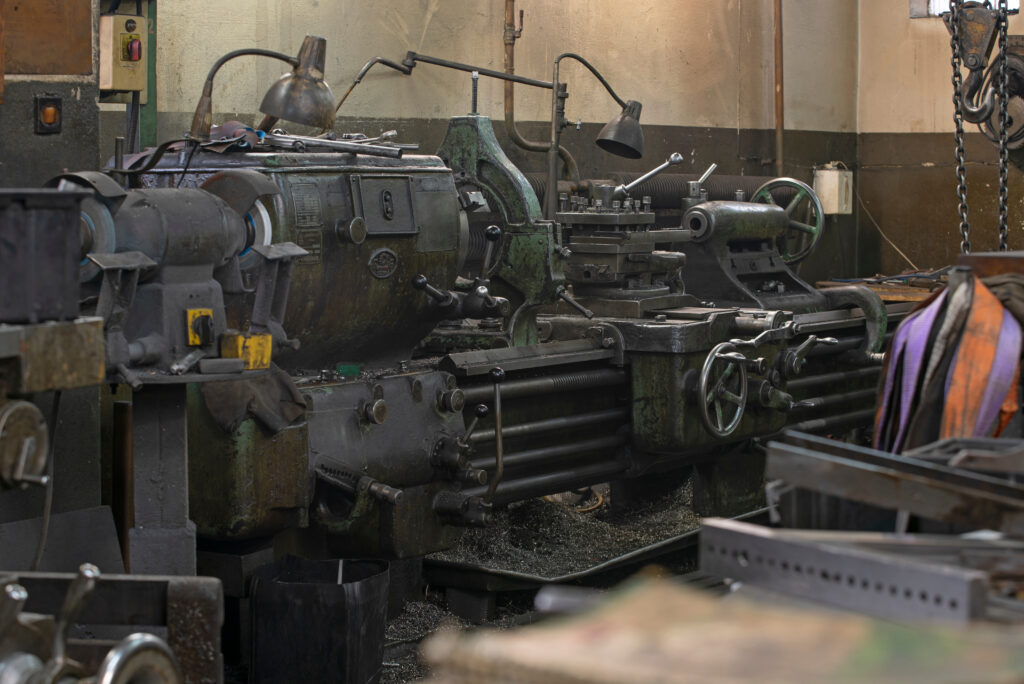

Key takeaways:
The article explains when the modernization of a lathe is subject to the minimum requirements, and when it may mean the need to meet the essential requirements as for a new machine.
- Older lathes can usually be modernized, but you need to distinguish between minimum requirements and essential requirements.
- The minimum requirements arise from 2009/104/EC and the MG Regulation of 30.10.2002; the deadline for compliance expired on 1.01.2006.
- Minimum occupational health and safety measures include, among others, guards, an emergency stop, limit switches, and basic electrical protections.
- Essential requirements apply to “new” machinery under 2006/42/EC and the Machinery Regulation 2023/1230, including conformity assessment and CE marking.
- EN ISO 23125:2015-03 describes the safety of lathes; for CNC machines it requires, among other things, a mode selector switch (key-operated) and speed limitations in setting-up mode.
Bringing a lathe up to minimum requirements: Many companies still operate machine tools that were built decades ago. Customers often ask whether such an old lathe can be upgraded to meet current safety requirements. The answer is yes—in most cases it is possible, and often necessary to ensure safe operation. However, it is important to distinguish minimum requirements from essential requirements and to understand what it means to adapt a machine to each of these levels. In practice, the deadline for bringing older machines into line with minimum requirements passed back in 2006 (for machines purchased before 2003), yet many are still in service without a full upgrade—creating serious hazards for operators. Below, we explain the differences between minimum and essential requirements and outline how to approach a lathe retrofit so it meets current machine standards and safety regulations.
Minimum requirements vs essential requirements – differences and regulations
Minimum requirements are the basic occupational health and safety requirements applied to machines already in use in the workplace. Their purpose is to ensure a minimum acceptable level of safety so that the machine can be legally operated without creating excessive risk. They include measures such as mechanical guards, emergency stop systems, limit switches, and basic electrical protection to safeguard the operator. In Poland, minimum requirements were implemented on the basis of the so-called work equipment directive (currently 2009/104/EC) concerning the use of machinery by employees. National regulations (the MG regulation of 30.10.2002) imposed on employers the obligation to bring older machines into compliance with minimum requirements by 1 January 2006. Minimum requirements therefore apply to machine users (employers), who must assess the condition of each machine in use and ensure it can be operated safely on a day-to-day basis.
Essential requirements, by contrast, are a much broader set of safety criteria, mandatory for new machines placed on the market (under Directive 2006/42/EC or the Machinery Regulation 2023/1230). They cover all relevant safety and health aspects already at the machine design and build stage. A machine that meets essential requirements should undergo a full conformity assessment, including a detailed risk assessment, have complete technical documentation, and a EC/EU declaration of conformity. In other words, the manufacturer (or the party modernising the machine) must ensure the machine meets the so-called essential occupational health and safety requirements, which is confirmed by affixing the CE marking. Essential requirements are more stringent—they include, among other things, the use of harmonised standards in the design, the safety of control systems, ergonomics, noise and vibration emissions, electromagnetic compatibility, and so on.
Who do the individual requirements apply to? Minimum requirements fall on the employer as the machine user (they must bring an old lathe in their facility up to the minimum safety level), whereas essential requirements apply to the manufacturer or the party carrying out the modernisation who places the machine on the market as “new”. In practice, if an old lathe is substantially modified—for example, by adding a new CNC control system or carrying out major mechanical rebuilding—it may need to be treated as a new machine and meet the full set of essential requirements, including renewed CE certification. It is therefore always worth assessing the scope of the upgrade: minor improvements (guards, pushbuttons, replacement of the electrical installation) are mainly aimed at meeting minimum requirements, but a comprehensive rebuild may require an essential-requirements approach (including the conformity assessment procedure).
In summary: the minimum requirements are the absolute baseline for safety (which every lathe in use should already meet, because this is required by law), while the essential requirements are the full set of obligations applicable to a new machine. The good news is that the scope of both lists overlaps in many areas. So if you upgrade an older lathe in line with the National Labour Inspectorate (PIP) guidance on minimum requirements, in practice the machine will already largely meet the essential requirements as well (with formal documentation and certification still to be addressed, among other things). Below we present the most important standards and guidelines worth considering when planning such a retrofit.
EN ISO 23125:2015-03 – lathe safety
One of the standards describing requirements for lathes is EN ISO 23125:2015-03 (machine tools – safety – lathes). This is a harmonised type C standard, providing a presumption of conformity with the Machinery Directive for lathes. The standard divides lathes into four groups based on design and control method:
- Group 1: Manually controlled lathes, without numerical control (classic universal lathes, fully manual).
- Group 2: Manually controlled lathes with limited CNC functionality (e.g., semi-automatic machines, lathes with simple numerical control or a cycle).
- Group 3: CNC lathes and turning centres (fully numerically controlled).
- Group 4: Automatic single- or multi-spindle lathes (e.g., automatic lathes for high-volume production).
Appropriate operating modes and safety measures are specified for each group. Operating modes (mode) are precisely defined: for example, Mode 0 is manual mode, Mode 1 is automatic, Mode 2 is set-up mode (setting/configuration), and there is also a service mode. The standard requires CNC lathes (groups 3 and 4) to have an operating-mode selector switch—a key switch that enables set-up mode with limited speed and service mode. This means, for example, that tool setting or measurement on CNC lathes can be carried out with the guard open, but only at significantly reduced axis and spindle speeds (so-called reduced speed in set-up mode)—which dramatically improves safety. In service mode, also accessible only by key to authorised personnel, calibration and maintenance activities are permitted, but without machining material. Purely manual lathes (group 1) do not require such mode selectors—the operator remains in direct control at all times, and the lathe should not be capable of automatic movement without the operator’s action.
Guards and mechanical protective devices: EN ISO 23125 places strong emphasis on guarding hazardous zones. Group 3 and 4 lathes must have near-complete enclosures (cabins) protecting the operator from fragments, chips, and coolant, fitted with interlocks that prevent the guard from being opened while the chuck is rotating. Manual lathes (group 1) should also have guards—for example, a chuck and tool guard (the so-called front chip guard) and guards for other moving parts (drive belt, clutches, lead screws, etc.), although these may be adjustable or fixed. It is important that guards are sufficiently mechanically robust. The standard even includes impact tests for guards—Annex A describes a method for testing guards by firing a mass at them at a specified speed to simulate a fragment or ejected object. This allows the manufacturer (or retrofit provider) to select a guard with an appropriate resistance class that will withstand the impact energy of a fast-moving piece of metal. For example, the enclosure guard on a CNC lathe is required to stop a fragment of a broken chuck jaw at maximum speed—the test parameters (projectile mass and speed) are specified in the standard based on chuck diameter.
Control system and electrics: The standard also refers to general occupational health and safety standards such as EN 60204-1 (electrical equipment of machines) and EN ISO 13849-1 (safety of control systems). The lathe should be fitted with a main power isolator (disconnect switch) in a clearly marked, easily accessible location, separated from the control panel so that power can be disconnected without confusion before service work. The electrical installation must protect against electric shock—all metal parts should be earthed, and the effectiveness of shock protection should be regularly verified by measurements carried out by a competent person. Motors and drive systems require overload and short-circuit protection. An emergency stop (E-Stop) is mandatory (unless the risk does not require it—for example, on very small, simple machines, which is a rare exception). The standard requires that pressing the emergency mushroom button immediately stops hazardous movements (stop category 0 or 1 according to EN 60204-1/ISO 13850) and removes power from the drives, and that releasing the button must not automatically restart the machine. Restart after an emergency stop must require a deliberate operator action (reset and restart). Visual/audible warning before automatic start-up, brakes that stop the spindle within a reasonable time, and protection against unexpected start-up after power is restored—these are further aspects the standard highlights. EN ISO 23125 also includes a list of hazards and protective measures (more than 20 pages of guidance in Clause 5), covering, among other things, machine stability, sharp edges, workstation ergonomics, as well as user information (Clause 6 specifies the required marking on the machine and the content of documentation, e.g., the operating instructions).
Fire risk and other hazards: Interestingly, Annex E of the standard addresses fire hazards—for example, when using coolant with an oil content of >15%, there is a risk of ignition or explosion of vapours. For this reason, it recommends using ventilation/extraction systems and even fire-suppression systems on lathes operating with coolant (“wet” machining). When upgrading an old lathe, it is worth taking these aspects into account as well—for example, by installing splash guards for coolant, temperature sensors (for heavy-duty machining), or at least keeping a fire extinguisher near the workstation.
In summary, EN ISO 23125:2015 is a comprehensive guide on how to design (or modernise) a lathe so that it meets the essential safety requirements. Below, we will discuss the PIP guidelines relating to minimum requirements—and we will see that they align with many of the standard’s recommendations.
Adapting a lathe to minimum requirements: PIP guidelines
The National Labour Inspectorate has developed checklists and commentary to help employers bring older machines into line with minimum occupational health and safety requirements. Such a PIP checklist includes detailed questions covering various aspects of the machine—from workstation ergonomics, through the control system, to maintenance. It makes it possible to assess whether a given lathe meets minimum standards and, if not, what corrective actions should be implemented. Here are the key areas PIP focuses on (in simplified form):
- Risk assessment: Has a risk assessment for lathe operation been carried out, and have the hazards been identified? (This is fundamental—risk analysis should be the starting point for any retrofit or upgrade).
- Controls: Are the buttons and levers clearly labelled (descriptions in Polish or understandable symbols), easy to reach, and outside the hazard zone? Are they protected against accidental actuation? The National Labour Inspectorate (PIP) recommends introducing standardised colour coding: green button—start, red—stop, red mushroom on a yellow background—emergency stop. Controls should be positioned at a height of at least 0.6 m above the floor and away from moving parts of the machine tool.
- Guards and protective devices: Are the moving parts of the lathe properly guarded or protected by other means (light curtains, interlocks, etc.)? According to the guidelines, all components that could cause an accident should be guarded or fitted with protective devices that prevent access to hazardous areas. Fixed guards must be securely fastened, and movable guards must be fitted with functional limit switches (interlocks) that monitor their position. The National Labour Inspectorate (PIP) also recommends regular functional testing of guards and interlocks—for example, periodic checks that opening a guard actually stops the spindle.
- Emergency stop system: Does the machine have an emergency stop (E-Stop) device, and is it operational? The absence of an emergency stop may be acceptable only when its presence would not reduce risk (e.g., it would not shorten stopping time)—in practice, a lathe should almost always have one. The National Labour Inspectorate (PIP) requires the E-Stop mushroom to be readily accessible from the operator’s working position (sometimes several buttons are needed around a larger machine) and clearly distinguishable by colour and shape. Pressing the E-Stop must immediately stop all hazardous movements, and it must not be bypassed in any machine operating mode. Importantly, after an E-Stop is activated, restarting the lathe should require releasing (resetting) the button and starting the machine again—never automatically.
- Electrical installation and shock protection: Is the lathe protected against electric shock? This includes checking the condition of cable insulation, grounding/earthing, and the presence of a main isolator. The National Labour Inspectorate (PIP) requires documentation of protective electrical measurements (insulation resistance, effectiveness of neutralisation/earthing) performed by a qualified person. The machine should also have an easy-to-use power isolator to disconnect electrical energy (and pneumatic, hydraulic energy if applicable) before service work.
- Ergonomics and housekeeping: Is the workstation at the lathe well lit and free of factors that hinder work? Lighting should meet standards—an illuminance of at least 200 lx at the lathe workstation is recommended (more for precision work). The floor should be level and slip-resistant, and spilled coolant or scattered chips must not create a trip or slip hazard. The National Labour Inspectorate (PIP) highlights the need to keep the area clean—for example, equipping the machine with chip bins, coolant splash guards, etc., to minimise mess around it. Operational ergonomics are also important—for example, convenient access to the chuck, tailstock, and control panels at an appropriate height, without forcing the operator into awkward postures.
- Markings and instructions: Are the required safety signs present on the machine, and have operators been trained in safe operation? The National Labour Inspectorate (PIP) requires clear warnings to be placed on the machine tool—for example, a warning symbol for moving parts, for electric shock risk, information on the need to wear safety glasses when chips are present, etc.. They should be in Polish or in the form of pictograms understood by the workforce. In addition, every machine must have an operating manual (the so-called DTR—technical and operational documentation) available to the operator. The employer must train employees on occupational health and safety rules for operation—job-specific training should include a demonstration of guard operation, the emergency stop procedure, cleaning and maintenance tasks, etc.. The rules should also be reinforced regularly (e.g., no working in loose clothing, no use of gloves near a rotating chuck, mandatory eye protection, etc.).
- Maintenance and inspections: Does the lathe have an inspection plan, and does the staff know how to perform maintenance safely? Minimum requirements stipulate that all setup work, adjustments, and lubrication must be carried out with the machine stopped. If, exceptionally, something must be done while running (e.g., levelling a part during rotation), special measures must be implemented (low speed, auxiliary devices). The machine should be isolated from energy sources during repairs—here again, the main isolator is important, as it can be locked (the LOTO—lockout/tagout principle). The National Labour Inspectorate (PIP) recommends keeping an inspection log—regular checks of guard condition, brake checks, replacement of worn components. A faulty lathe must not be operated—if defects posing a threat to life are identified, a PIP inspector may immediately stop its use.
As you can see, the PIP guidelines largely align with the requirements of the standard—they emphasize guarding, emergency stop, reliable electrics, signage, ergonomics, and organizational procedures. Once the machine is brought into line with these recommendations, the risk of an accident is significantly reduced, and the lathe meets the legal minimum for safety. In practice, it often turns out that meeting the minimum requirements (using supporting standards) means the machine almost meets the essential requirements—it is simply missing formal certification. Below is a brief summary of the most important differences for a lathe.
| Objective | Suggested minimum | When you need to “go further” |
|---|---|---|
| Meet only the minimum requirements | – Audit using the PIP checklist; – Add guards (without an impact test; you can use FEA or an energy calculation spreadsheet); – One E‑Stop circuit, conventional contactors; – Documentation: risk assessment + workstation instruction; | When you are not changing the machine’s function (e.g., it remains manual) and the upgrade does not create new risks |
| Move closer to essential requirements / CE | Additionally: – PLr marking / categories, safety controller; – Operating mode selector, reduced speeds; – Documented guard resistance class (test or justified calculations); – Full technical documentation and declaration of conformity; | When you introduce a substantial modification (e.g., a CNC retrofit, a new drive system) or you plan to sell/relocate the machine as “new”. |
Adapting a lathe to the minimum requirements – practical guidance
Modernizing a lathe should start with a safety audit and a risk assessment. Based on this, a list of gaps and hazards to be eliminated is prepared. These are the main areas that typically need attention when upgrading an older general-purpose lathe:
Guards and mechanical protective measures
Providing appropriate guards is the top priority. On older lathes, there was often no factory-fitted chuck guard or cutting-zone guard—today it needs to be added. The best solution is a hinged chuck guard with a transparent screen (e.g., polycarbonate) and a limit switch. Such a guard protects the operator from chips and coolant, and opening it should automatically stop the spindle. It is important that the guard material is impact-resistant—for example, a few millimeters of polycarbonate will stop small fragments, but stopping larger pieces may require reinforcement with a metal frame. On large enclosed lathes, the entire working area should be closed within an enclosure; for smaller chuck lathes, a chuck-and-tool guard is the minimum. In addition, fit guards on the lead screw and feed rod (e.g., telescopic or spiral), guards on drive belts and gear trains (e.g., metal covers with a sensor if belt access is required), and also on other protruding moving parts (handles, levers) if they create a risk of clothing being caught.
Pay attention to the rear zone of the lathe—chips are often thrown in that direction. It is worth installing a rear chip guard or a belt-pulley enclosure that also provides chip protection. Secure all fixed guards so that a tool (screwdriver) is required to remove them—this helps prevent the crew from bypassing safeguards. Movable guards, in turn, should be fitted with electrical interlocks (safety switches compliant with EN ISO 14119) that stop the machine if someone attempts to open them. After the upgrade, tests should be carried out—for example, verifying that opening the chuck guard actually stops the spindle within the required time.
Do not forget about protection against fragments and chips. Long, sharp chips are a common issue when turning steel—they can cut the operator or even cause burns (they are very hot). That is why chip breakers are used (special insert geometries or additional chip-breaking elements), along with screens to protect the operator’s eyes and face. A polycarbonate chuck guard partly serves this purpose, but you can also install a transparent guard above the tailstock to catch chips spraying toward the operator. If there is a risk of a larger object being ejected (e.g., a workpiece coming loose from the chuck), the only effective measure is a closed cabin or a robust energy-absorbing guard. In practice, the lathe doors can be reinforced with sheet metal or a special laminated window. In line with standards, guards must withstand the impact of potential fragments—for example, a broken tool or a grinding wheel (if the lathe has a grinding attachment). The use of guards with energy-absorbing panels or polycarbonate screens that will not shatter on impact is recommended.
To wrap up this stage: any part of the lathe that rotates or moves and could pose a hazard should be physically separated from the operator—either by a guard or by a protective device (e.g., a light curtain that detects presence in the hazardous area). When retrofitting a manual lathe, pay particular attention to the chuck guard, drive transmission guards, way/slide guards, and safeguarding the chip ejection area. This often means fabricating custom guards—it’s worth using off-the-shelf, certified lathe guards (many companies offer dedicated workplace safety guards for popular models), or making them in-house to good engineering practice (material thickness, secure mounting, suitable limit switches, etc.).
Control system and electrical safety
The second critical area is the lathe’s controls and electrical system. Older lathes often have outdated electrics: contactors without protection, worn cable insulation, no main isolator, or no emergency stop button. The retrofit should include a complete inspection of the electrical installation. What needs to be done?
- Main power isolator: Install a clearly labelled main isolator (main disconnect) that cuts power to the entire machine. It should have “I/0” (on/off) positions and be lockable in the OFF position (e.g., with a padlock) during servicing. It’s important that it isn’t located right next to the normal control buttons—ideally place it on the side of the electrical cabinet or at the rear of the machine—so you have to deliberately walk up to it.
- Emergency stop (E-Stop): If the lathe doesn’t have one, add it—no exceptions. The standard is a red mushroom button on a yellow background, latching automatically when pressed. Mount it within the operator’s reach—typically on the front panel of the lathe. On larger machines, additional E-Stops are also fitted on the opposite side (e.g., behind the spindle) or at other operating positions. The emergency stop should immediately remove power to the spindle motor and feeds (category 0 – power removal). This requires wiring it into a safety circuit—preferably via a safety relay (compliant with EN ISO 13849-1). Such a relay monitors the E-Stop loop (e.g., two normally closed contacts in the mushroom button) and controls the contactors that disconnect power to the motors. This improves reliability—even if one contact fails, the machine will stop (safety category 3 or 4 as required). After an E-Stop is pressed, the system must require a manual reset (release the mushroom button and press a reset button) before it will allow the drive to be started again—preventing an unexpected restart.
- Rapid stopping of motion: On lathes, the spindle stopping time after shutdown is critical. Older machines can “coast” for a long time due to inertia. Consider adding a spindle brake—mechanical (e.g., a shoe brake on the shaft) or electrical (a dynamic braking module for the motor). This improves safety (faster deceleration of the rotating chuck) and also makes the machine more pleasant to use. Modern lathes often use a VFD with DC braking or a dedicated electromagnetic brake. Make sure that when a guard is opened or the E-Stop is pressed, the brake also engages, reducing the stopping distance. After the retrofit, it’s worth measuring the spindle stopping time from different speeds and comparing it to the standard—this makes it easier to determine safe distances for light curtains or the required warning-signal time.
- Controls and logic: Older lathes typically use contactor-based control circuits. A retrofit lets you introduce new control logic—e.g., via a safety PLC or time relays—but even without that, make sure the contactors are new and correctly rated. Replace old main contactors and add auxiliary relays for guard-control circuits. Use control pushbuttons with standard colour coding (green Start, black/white – normal Stop, red mushroom – emergency stop). Consider adding a power-on indicator lamp and a start-up warning signal (if it’s a CNC lathe). Make sure there is no possibility of automatic start—for example, after power returns following an outage, the lathe must not start by itself. In a contactor circuit, this is achieved using seal-in (holding) contacts in the Start circuit, which require the Start button to be pressed again after a power loss. Also check that the machine does not start when the E-Stop is reset—a common fault in older circuits is that releasing the mushroom button suddenly energises the machine (this must be eliminated).
- Electrical installation: Replace worn electrical cables with new ones, using insulation resistant to oils and temperature. Route them in cable ducts or conduits to protect them mechanically. Check the condition of the motor and terminal box—clean or replace as needed. Add any missing protective earthing—for example, bonding straps connecting the electrical cabinet door to earth, and equipotential bonding between the machine frame and guards (so a metal guard is earthed as well). Install a suitably rated residual current device (RCD) in the electrical cabinet to improve shock protection (although its use in machine circuits can be debated due to leakage currents—the decision is made by the electrician). In any case, every motor circuit must have overcurrent protection (a motor protection circuit breaker with thermal overload, or fuses). Have the entire installation tested—insulation resistance and effectiveness of protective measures—and keep the test reports.
- Lighting and add-ons: Consider adding task lighting for the machining area. Modern lathes use LED lights resistant to vibration and coolant, mounted inside the enclosure. On an older lathe, you can fit a workshop lamp with an articulated arm so the operator can clearly see the turning area—this supports both ergonomics and safety (better visibility reduces the risk of mistakes). Also ensure there is a limit switch on the guard—all movable guards (e.g., a hinged belt cover, headstock enclosure doors) should have safety interlocks that shut down the drive when opened. Choose components certified for safety functions (category 1-3 depending on risk). After installation, carry out functional tests: press the E-Stop—the machine must stop; open a guard—the spindle must not be able to start or must stop; switch off the main power—everything goes dead, etc. These tests must be documented.
Bringing a lathe into line with the minimum and essential requirements is an investment in safety, legal compliance, and efficient operation. Although the formal obligation to adapt “older” machines to the minimum requirements expired in 2006, many plants still run equipment that does not meet even these basics. These are ticking time bombs—the risk of an accident or breakdown is high, and the legal consequences for the employer can be serious. Fortunately, as described above, most shortcomings can be addressed through relatively straightforward upgrades: installing guards, adding emergency stop devices, tidying up the electrical system, implementing standards-compliant lathe safeguards, and updating work procedures.
It is worth relying on recognised standards (such as EN ISO 23125 for lathes and the related Type B standards), which point to specific technical solutions. The PIP guidance and the health and safety checklist are also excellent reference points—once implemented, the machine will be safe and legally compliant. A well-executed upgrade will ensure that our old lathe meets the minimum requirements, and in many respects also the essential requirements. If the scope of changes is extensive, consider whether the machine should be legalised through a renewed conformity assessment and CE marking—especially when the machine’s operation changes significantly.
Most important, however, is a practical approach: regular risk assessment for the workstation, consultation with employees (often the operator will point out where the danger is “lurking”), and then systematic elimination of hazards—through technical or organisational measures. Machine safety is not optional; it is a duty of every employer and manufacturer. By modernising lathes and other machine tools, we not only meet regulatory requirements, but above all protect people’s health and lives and safeguard production continuity. If in doubt, it is worth seeking support from machinery safety specialists—their expertise will help select the right protective measures and carry out the entire process in line with current regulations and good engineering practice. This way, our machine modernisation will deliver lasting benefits and the peace of mind that we have done everything possible to make work on lathes as safe as it can be.
Adapting the lathe to the minimum requirements
Yes, in most cases this is possible and often necessary to ensure safe operation. The scope of the modifications depends on the machine’s condition and the planned upgrade.
Minimum requirements are the basic occupational health and safety requirements for machines already in use at the plant, so they can be legally operated without undue risk. Essential requirements are broader and apply to machines placed on the market as “new”, including conformity assessment and CE marking.
The minimum requirements apply to the employer as the machine user, who is required to assess its condition and ensure safe use. For machines purchased before 2003, the deadline for compliance with the minimum requirements expired on 1 January 2006.
When the modification is significant, for example adding a new CNC control system or carrying out a major mechanical rebuild, it may need to be treated as a new machine. In that case, the full essential requirements apply, along with a formal conformity assessment and CE marking.
This is a harmonized type C standard for lathes that specifies safety requirements depending on the type of machine and the control method (including groups 1–4). It also sets out, among other things, the approach to operating modes for CNC lathes and requirements for guards and interlocking devices.