
Key takeaways:
The article explains the formal definitions of the hazardous area in EU law and in national regulations, and presents typical hazard zones around industrial machinery.
- The hazard zone is an area inside or around the machine where there is exposure to a risk to health or life.
- Directive 2009/104/EC defines it as an area in which a worker is exposed to a safety or health hazard.
- Regulation (EU) 2023/1230 describes the zone in a similar way: in or around the machinery, a person may be exposed to a hazard.
- Polish occupational health and safety regulations (the Minister of Labour and Social Policy Regulation of 26.09.1997) require hazardous zones to be designated and marked.
- Examples: robotic cells, presses and machine tools, movement of forklift trucks and overhead cranes, and areas near furnaces and turbines
A hazardous zone is an area within a machine’s working space where there is a risk to the health or life of people present. Both EU rules on the use of machinery by employees and regulations on machine design include formal definitions of this term. Directive 2009/104/EC (the so-called work equipment directive on minimum occupational health and safety requirements for the use of work equipment) defines a hazardous zone as
“any zone within or around work equipment in which an employee is exposed to a risk to their safety or health” (eur-lex.europa.eu).
Meanwhile, the latest Regulation (EU) 2023/1230 on machinery (the successor to the Machinery Directive 2006/42/EC) defines a hazardous zone in a very similar way—as
“a zone within or around machinery or a related product in which a person present may be exposed to a risk to health or safety” (eur-lex.europa.eu).
In practice, both definitions emphasize that a hazardous zone is any space around or inside equipment where there is exposure to injury or an accident.
This concept is also used in Polish national legislation. For example, the MPiPS Regulation of 26 September 1997 on general occupational health and safety provisions requires hazardous zones in the workplace to be designated and marked. All of these regulations—both EU and national—share one core principle: the hazardous zone must be clearly separated and employees must be made aware that they need to exercise particular caution in this area. In other words, the employer is required to mark and safeguard hazard zones in such a way that no unauthorized person can accidentally enter a machine’s hazardous zone.
Practical examples of hazardous zones in industry
Hazardous zones occur in almost every industrial sector—wherever machines and equipment create hazards. Below are a few typical examples where defining a hazardous zone is critical to employee safety:
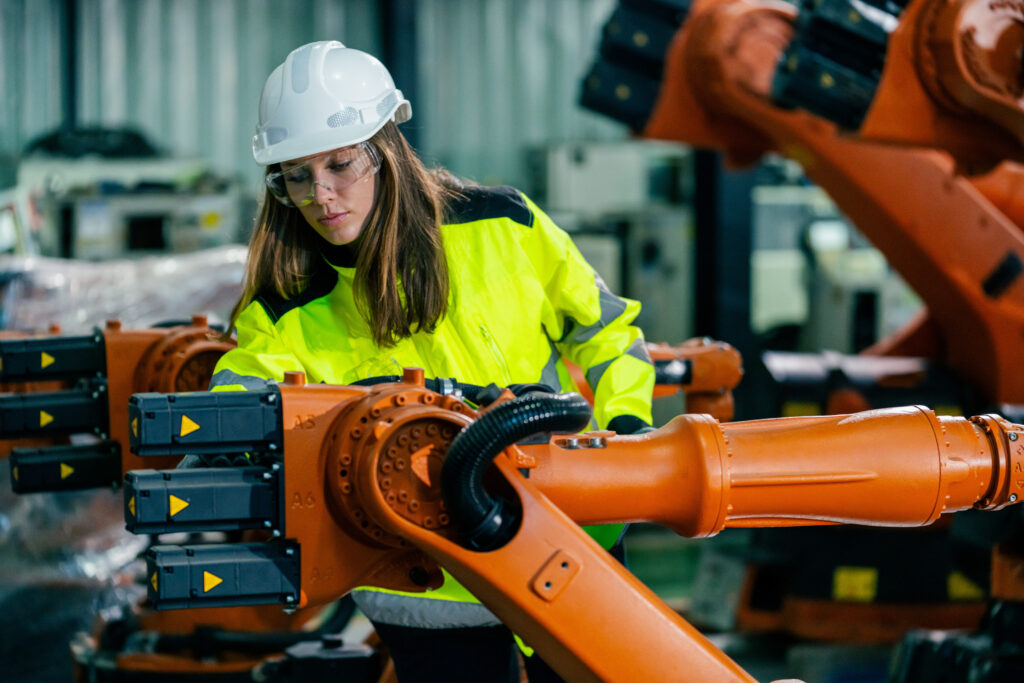
- Robotic cells in automotive and on production lines: In the automotive industry and, more broadly, on automated production lines, industrial robots are widely used. Their working envelope is a classic hazardous area—the robot arm has a long reach and moves at high speed, creating a risk of impact or crushing. Standard practice is to enclose such a robotic cell with physical guarding and fit access gates with safety interlocks so that opening the door immediately stops the robot’s motion. In addition, the robot’s work area is often monitored with sensors (e.g. pressure-sensitive safety mats laid around the cell—stepping on a mat stops the machine) and laser scanners. The aim is to prevent accidental entry into the robot’s hazardous area and to ensure immediate emergency stop if the zone is breached.
- Machining equipment and industrial presses: Machines such as mechanical presses, guillotine shears, CNC lathes, and milling machines have hazardous areas around cutting or crushing tools. For example, a hydraulic press has a tooling zone where the operator loads and unloads parts—this is an area with a particularly high crushing risk. To protect the worker, fixed guards (e.g. closable guards around the tool) or protective devices are used: light curtains, photoelectric barriers, or two-hand control buttons. When the operator’s hands must approach the press working area, a light curtain can detect an intrusion and stop the cycle before contact with a hazardous element occurs. Standards such as EN ISO 13855 precisely define the required safety distances for positioning these sensors relative to the hazard zone, so the machine has time to stop before a person can reach the dangerous part.
- Internal transport and warehouses (forklifts, overhead cranes): In warehouse and production environments, mobile equipment also creates hazard zones. Forklift routes should be separated from pedestrian walkways, often using painted floor lines and warning signs. The hazardous area includes the vehicle’s swept path and turning radius—unauthorised personnel should not enter it while the truck is moving. Similarly, overhead cranes and jib cranes have variable hazard zones depending on their position. The risk comes both from the moving crane components and from the possibility of a lifted load falling. For this reason, the area beneath an operating crane is often marked as off-limits to personnel, and modern systems even use laser projectors that display virtual lines and warning symbols on the floor, dynamically indicating the crane’s current working range.
- Heavy industry and power generation: In steelworks, foundries, or power plants, hazardous areas may include zones around furnaces, turbines, boilers, etc. Risks there include, for example, high temperatures, metal spatter, noise, or moving machine parts. Workers must exercise particular caution, use personal protective equipment, and the employer clearly marks the boundaries of hazardous areas with signs and barriers. Light and audible signalling is also commonly used—for example, alarm sirens activated before a large machine starts, or red warning lights indicating that you are entering a hazardous area.
Of course, the examples above do not cover the whole topic—a hazardous area exists wherever machine operation can cause injury. Importantly, these zones apply both to places with постоян or frequent access and to those that workers enter only occasionally. Any such area is potentially dangerous and must be included in the hazard analysis and safeguarded appropriately.
Employer responsibilities – labour law and protective measures
Providing a safe working area around machinery is not merely a matter of the employer’s goodwill; above all, it is a legal duty arising from labour law and occupational health and safety regulations. The Labour Code (Articles 215–218) requires that machines used in the workplace provide safe and hygienic working conditions. The employer must ensure that equipment is properly selected, installed, and maintained, and that it is fitted with the necessary safeguards to protect employees from accidents.
The above-mentioned Directive 2009/104/EC clearly places an obligation on the employer to provide employees with work equipment that does not endanger their safety and health. If risk elimination is not fully possible, the employer should implement measures to reduce the risk to an acceptable level. In practice, this means the need to bring machines into line with minimum occupational health and safety requirements – including by fitting them with guards, protective devices, functional emergency control systems, proper workplace lighting, etc. The employer should also carry out regular inspections of the technical condition of machines and their safeguards. This requirement is reflected in Polish implementing regulations – for example, the regulation on the operation of machinery specifies the need for inspections and maintenance to keep equipment in a safe condition.
An important part of these duties is also organising work in a way that limits people’s exposure to being in hazardous zones. The employer should establish procedures that define who may enter a dangerous area, when, and under what conditions (e.g., authorised personnel only, with the machine switched off and after applying specified safeguards). Lockout/Tagout systems are often used – procedural isolation of energy sources and tagging to indicate that the machine is shut down for servicing, so that no one starts it while someone is inside the hazardous area. In addition, the employer must mark such zones and hazards using safety signs compliant with standards (warning pictograms, signs indicating that unauthorised persons are prohibited from entering, safety lines and colours on the floor, etc.). All of these organisational measures complement technical machine safeguards, creating a coherent system for protecting employees.
It should be emphasised that failure to comply with occupational health and safety requirements relating to machinery and hazardous zones can lead to serious legal and financial consequences. Supervisory authorities (e.g., the labour inspectorate, UDT) are entitled to impose penalties if deficiencies are found at the site – for example, missing required guards or unmarked hazard zones. Companies that ignore the obligation to bring machines into compliance with minimum requirements expose themselves to administrative sanctions and an increased risk of accidents. Moreover, meeting all legal requirements is not only about avoiding fines – it is also part of building a company’s reputation. A business that prioritises safety earns the trust of customers and partners and gains a competitive advantage. That is why compliance with EU and national occupational health and safety regulations should be treated as a priority by every employer.
Risk assessment and technical safeguarding measures
Risk assessment is the foundation for effectively defining hazardous zones and selecting protective measures. Both EU legislation and harmonised standards (e.g., EN ISO 12100) require that, before a machine is put into service, an analysis of all potential hazards is carried out. As part of such an assessment, hazardous zones are identified, the types of hazards are determined (mechanical, electrical, thermal, noise, chemical substances, etc.), and the likelihood of an accident and its potential severity are evaluated. Next, risk reduction measures are planned – with technical measures as the first priority. In practice, this means that already at the design stage or during machine modernisation, efforts are made to eliminate hazards at the source (e.g., replacing a hazardous process with a safer one, using lower-energy components). If a hazard cannot be eliminated, appropriate technical safeguards are designed to prevent human contact with the dangerous part or to stop the machine before an accident occurs.
Key technical protective measures include: fixed and movable guards, protective barriers and fencing, interlocking devices (interlocks) associated with guards, light curtains and photoelectric safety barriers, laser scanners, pressure-sensitive mats, and emergency stop devices. All of these are intended to protect the machine’s hazardous area. For example, fixed guards (enclosures, covers) physically prevent access to the danger zone (e.g., a guard over gearboxes or power transmission belts). Interlocked movable guards ensure that opening a door or hatch stops hazardous motion—preventing a hand from reaching into moving mechanisms. Photoelectric sensors (light curtains, safety light barriers) create a virtual fence—if a person enters the protected area (breaks the light beam), automation switches off the machine’s hazardous motion. Correct design of such systems is essential—particularly maintaining the minimum distances from the hazardous area, which depend on the machine’s response time, so that beam interruption always occurs early enough. Harmonized standards (e.g., the aforementioned EN ISO 13855 or ISO 13857) specify concrete distance values and guard dimensions that ensure effective protection.
Another technical measure is enforcing safe operation—for example, two-hand control on presses requires the use of both hands to initiate the cycle, preventing accidental placement of a hand under the ram. Similarly, hold-to-run controls (so-called dead-man switches) or reduced speed in the machine’s setup mode are ways to minimize risk when the operator must be close to the hazardous area. For more complex production lines, safety-related control systems (Safety PLC) are used; they monitor sensor signals and, if a hazardous situation is detected, automatically stop the equipment. Such systems must comply with stringent standards (e.g., EN ISO 13849-1 or IEC 62061) to ensure their reliability.
In summary, technical measures—from simple guards to advanced safety electronics—are crucial for safeguarding hazardous areas. However, their selection should always be based on a properly conducted risk assessment. Only then can we be confident that each identified hazard has been assigned an appropriate technical safeguard or a solution that eliminates the risk. Importantly, the employer must ensure these devices remain in good working order—testing them regularly, inspecting them (e.g., daily tests of safety light curtains before the machine is put into operation), and maintaining them. Deliberately disabling or bypassing protective devices (so-called safeguarding defeat) is unacceptable—it directly endangers workers’ lives and is strictly prohibited by regulations.
Employee training, information, and signage
Even the best technical measures will not do their job if the person—operator or maintenance staff—does not understand the hazards and does not follow safety rules. That is why education and information are an equally important pillar of accident prevention. The employer has a legal obligation to train employees in occupational health and safety before allowing them to work at a given workstation. Job-specific training should include a thorough explanation of which hazardous areas are present when operating the machine, which actions are prohibited (e.g., reaching behind an active guard, going around barriers and fencing, tampering with sensors), as well as how to respond in emergency situations. It is essential that the operator understands all safety-related signals and instructions. For example, if the machine is equipped with a visual and audible alarm, the employee must know that a flashing red light means they must not enter the area because machine movement is about to occur.
Every machine should have a complete set of operating instructions and safety instructions, provided by the manufacturer or developed internally, describing, among other things, hazards, hazardous areas, and required precautions. The employer’s responsibility is to make this information available to employees in an understandable form (preferably in Polish if the original documentation is in a foreign language) and to enforce compliance. The instructions should be readily accessible at the workstation (e.g., as a printed copy near the machine).
Machine and workplace signage is another key information element. Hazard zones should be marked with warning signs (e.g., a yellow triangle with a hazard symbol—“Warning! Hazard area”), and prohibition signs should be posted at entrances to fenced-off areas (e.g., “No entry—authorized personnel only”). Warning lines (yellow-and-black stripes) are often painted on the floor or applied as tape to visually define the boundary of the hazard zone. In modern plants, the previously mentioned projected marking systems are increasingly used—for example, laser lines on the floor projected by projectors that dynamically indicate a machine’s working area or a vehicle’s travel path. Solutions like these can be more flexible than painted lines—they can be easily adjusted when the workstation layout changes or when the hazard zone needs to be expanded.
It is also important to remember personal protective equipment (PPE) and how it relates to hazard zones. Employees should be provided with, and trained to use, appropriate PPE such as hard hats, safety glasses, earmuffs, gloves, or protective footwear—according to the hazards present in a given work area. While these measures do not eliminate the hazards themselves, they reduce the consequences of potential accidents and serve as the last layer of protection if other safeguards fail. However, PPE must not be used as an excuse for missing safeguards—consistent with occupational health and safety principles, risk is addressed at the source first through engineering and organizational controls, and only then is the worker additionally protected on an individual basis.
In summary, training, procedures, and signage build a safety culture in the plant. An employee who understands the hazards and is trained in safe machine operation is far less likely to be involved in an accident. Clear markings and alarm signals also ensure that even bystanders or newly hired staff understand where hazard zones are located and how to behave near them. The employer should periodically refresh health and safety training, especially when new machines are introduced, processes change, or new hazards are identified. Documenting training and confirming that staff have reviewed instructions is also important from an evidentiary standpoint—it shows that the company is meeting its obligation to inform employees about occupational risk.
New technologies and defining hazard zones
The rapid development of industrial technologies (Industry 4.0, automation, robotics) is also changing how hazard zones are defined and monitored. Traditionally, the approach relied mainly on physical barriers (fences, guards) and simple sensors. Today, increasingly intelligent safety systems are emerging: advanced sensors, networks of IoT devices, and even elements of artificial intelligence that help improve safety.
Vision sensors and AI – Modern systems can use cameras and AI algorithms to supervise hazard zones. For example, a camera with image analysis can detect whether a person has entered a restricted area (human-shape recognition) and issue a command to stop the machine. AI can also monitor whether employees are wearing the required PPE in specific zones (e.g., detecting a hard hat or safety glasses) and generate an alert if it identifies non-compliance. These solutions are only now gaining traction, but in the future they may become an important complement to traditional safeguards, especially where flexibility and adaptability are needed. One example is collaborative robots (cobots), which, thanks to built-in force and vision sensors, can work alongside people without rigid fencing—slowing down or stopping when a person gets too close. In such applications, AI helps the machine “sense” human presence and respond dynamically, which redefines the traditional boundaries of hazard zones.
Virtual barriers and geofencing – Another trend is replacing physical markings with virtual ones. The laser projectors mentioned above can display lines or symbols on the floor that define a hazard zone and can move automatically along with the machine’s motion (e.g., an overhead crane). There are RFID or UWB systems for tracking the location of people and equipment—an employee equipped with an RFID tag, when approaching a hazard zone, can receive an automatic warning (e.g., vibration or an audible signal from a device mounted on the hard hat), and the machine can switch to a safe mode. Such geofencing improves safety especially around mobile machinery and autonomous vehicles (AGVs), creating an invisible barrier that responds to human presence.
Automation and integration of safety systems – New machines are increasingly designed with safety fully integrated into the control system. Light curtains and scanners are becoming the norm; they communicate with the machine controller via safety-rated protocols and can dynamically mute (temporarily disable) selected zones depending on the operating mode. For example, a robot can run at a higher speed when no one is nearby, but when an operator approaches, sensors detect this and automatically limit speed and range of motion before any contact occurs. Predictive solutions are also appearing more and more often—sensors monitoring vibration, temperature, or loads can anticipate failures, preventing sudden hazards (e.g., a tool breaking inside a machine) and raising an alert early enough.
However, new technologies do not remove the obligation to follow fundamental safety principles. On the contrary, they should be implemented to complement existing protective measures. Introducing collaborative robots or AI systems also requires updating the risk assessment and verifying that new risks (e.g., incorrect detection by AI) are properly addressed. Employers must keep up with technological developments and implement those improvements that genuinely increase the level of safety. Innovative systems—such as virtual zones, vision-based monitoring, or wearable sensors for employees—can significantly reduce the number of accidents, provided they are correctly integrated with occupational health and safety procedures and are reliable. One example of a successful innovation is replacing painted lines with virtual laser lines: they are more visible, do not wear off, and can be changed easily, improving both safety and the efficiency of work organization.
Recommendations for employers – a safe, compliant work environment
Providing a safe work environment when operating machinery is an ongoing, multi-faceted process. Below are key recommendations for employers; implementing them will help create a workplace that is compliant and free from accidents:
- Carry out regular machine safety audits: Machines and equipment should be inspected periodically for occupational health and safety compliance (such a safety audit can be performed by an in-house specialist or an external consulting firm). Check that guards are present and effective, safety devices function correctly, and signage and instructions are up to date. An audit helps identify weak points before an accident occurs and ensures compliance with the latest regulations.
- Bring machines into line with minimum requirements and regulations: If your plant uses older or modified machines, it is worth carrying out adaptation to the minimum requirements set out in Directive 2009/104/EC and national regulations. This may mean retrofitting missing guards, adding an emergency stop, upgrading the control system, or improving workstation ergonomics. Such measures reduce the risk of accidents and protect the employer from legal consequences. Note: check what constitutes a substantial modification.
- Ensure compliance with directives and standards (certification): When purchasing new machines, require the supplier to provide CE marking and a declaration of conformity with Regulation (EU) 2023/1230 on machinery (formerly the Machinery Directive). A machine that meets the essential requirements should be safe by design. However, CE marking alone is not enough—once the machine is installed at the site, a risk assessment for the specific application is still required. If there are doubts about compliance, you can commission certification or an assessment of machine conformity by independent experts. This is particularly relevant for machines built in-house or integrated production lines.
- Document and enforce risk assessment: Each machine workstation should have a current occupational risk assessment. This document must be made available to employees, and the preventive measures resulting from it must be implemented. A risk assessment is not “paperwork for the inspectorate”—it is a living document that must be updated with every process change, accident, or introduction of new technology. The employer should ensure that practical measures (guards, instructions, training) match what is stated in the risk assessment.
- Apply the hierarchy of protective measures: When designing safeguards, follow the principle: first eliminate the hazard, then apply engineering controls, then administrative controls, and finally personal protection. For example, if machine noise is hazardous, it is better to enclose the machine with a sound-absorbing guard (an engineering control) and limit exposure time (administrative), rather than relying solely on hearing protection (PPE). In the context of hazardous zones, try to organise the process so that the worker needs to enter the danger area as rarely as possible—and if they must, ensure the machine is switched off and secured.
- Invest in training and a safety culture: Don’t cut corners on occupational health and safety training and safe machine operation instruction. Employee training (both onboarding for new hires and periodic refreshers for experienced staff) increases hazard awareness and reinforces correct habits. Consider specialist courses, for example on the new machinery regulations 2023/1230 or control system safety—there are trainings dedicated to these topics that help engineering and management staff better understand legal requirements. A company’s safety culture starts at the top: leadership should lead by example, enforce compliance with rules, and recognise employees for reporting concerns about hazardous situations.
- Use modern solutions to improve safety: Stay up to date with safety technologies. Consider implementing, for example, light curtains, laser scanners, vision systems, or RFID interlocks where they can provide additional protection for hazardous areas. Where traditional fencing makes work difficult, virtual zones defined by light or sensors can be used. Remember, however, to test each technology for reliability before implementation and train employees on how it works. Technology should support—not replace—common sense and good occupational health and safety practices.
- Maintain good housekeeping and clear signage: Keeping the workstation tidy matters for safety. Floor markings must be visible (lines refreshed when worn, signs kept clean). Entrances to hazardous zones must not be blocked or chaotic—clear traffic routes should be maintained. Regularly check that warning signs and signals work (e.g., signal lights, alarms) and that employees understand them. If you introduce new markings (e.g., pictograms, colours), inform the workforce what they mean.
In closing, it is worth noting that a safe working environment around machinery is the result of many measures working together. Simply knowing the definition of a hazard zone from a directive or regulation is not enough—the key is applying that knowledge in practice on the shop floor. Employers should treat legal requirements as a minimum, not an end in itself. Striving for zero accidents requires continuous improvement—from investing in modern safeguarding solutions to building awareness and accountability among employees. This way, the hazard zone will remain, by definition, an area under control—properly safeguarded, clearly marked, and respected by everyone at the facility. Only then do occupational health and safety regulations translate into real protection of health and life, and the business can operate efficiently without unnecessary risk.
Hazard zone around machinery
This is the area inside or around a machine in which a person present may be exposed to a hazard to health or life. The definitions in Directive 2009/104/EC and Regulation (EU) 2023/1230 emphasize precisely the exposure of a person located within that space.
Directive 2009/104/EC states that it is any zone inside or around work equipment where a worker is exposed to a safety or health hazard. Regulation (EU) 2023/1230 describes it similarly as a zone inside or around a machine in which a person may be exposed to a hazard to health or safety.
Yes, national occupational health and safety regulations require hazardous areas in the workplace to be designated and marked. The aim is to clearly demarcate the hazard area and reduce the risk of unauthorized persons entering it accidentally.
This includes, among others, the robot working area in a robotic cell, the tool zone in presses and machine tools, as well as forklift travel routes and areas beneath overhead cranes. In the power sector and heavy industry, this may also include the vicinity of furnaces, turbines, and boilers.
This includes, among other measures, fencing and gate interlocks for robotic applications, fixed guards, light curtains, photoelectric safety barriers, and two-hand control on presses. In internal transport, route marking is used, as well as visual and audible signalling and sensors monitoring zone intrusion.